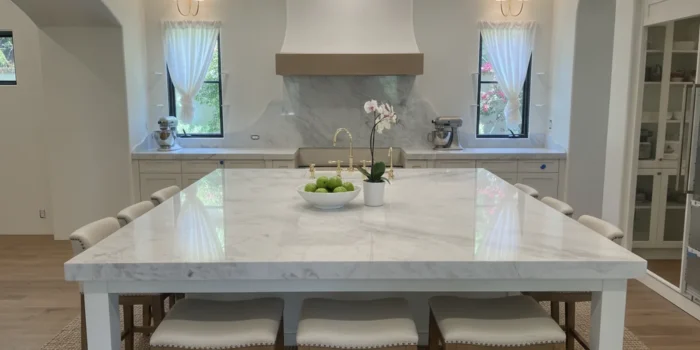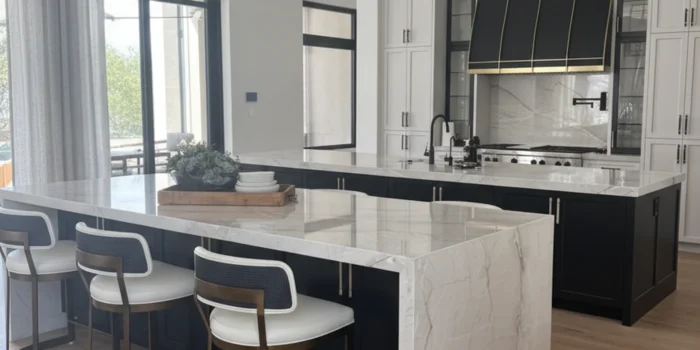
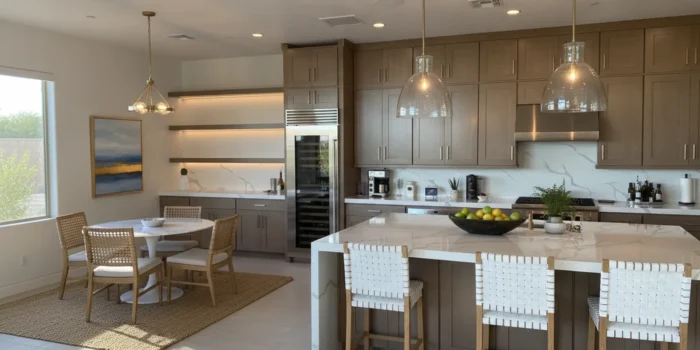
If you searched for taj mahal engineered quartz, you probably saw a warm cream countertop with soft taupe veining and decided that was the look. The catch is that “Taj Mahal” is the name of a natural quartzite, and engineered quartz is a different material that some brands style to resemble it. In a photo the two can look nearly identical. In a Phoenix, AZ kitchen they behave differently, and they are priced differently too.
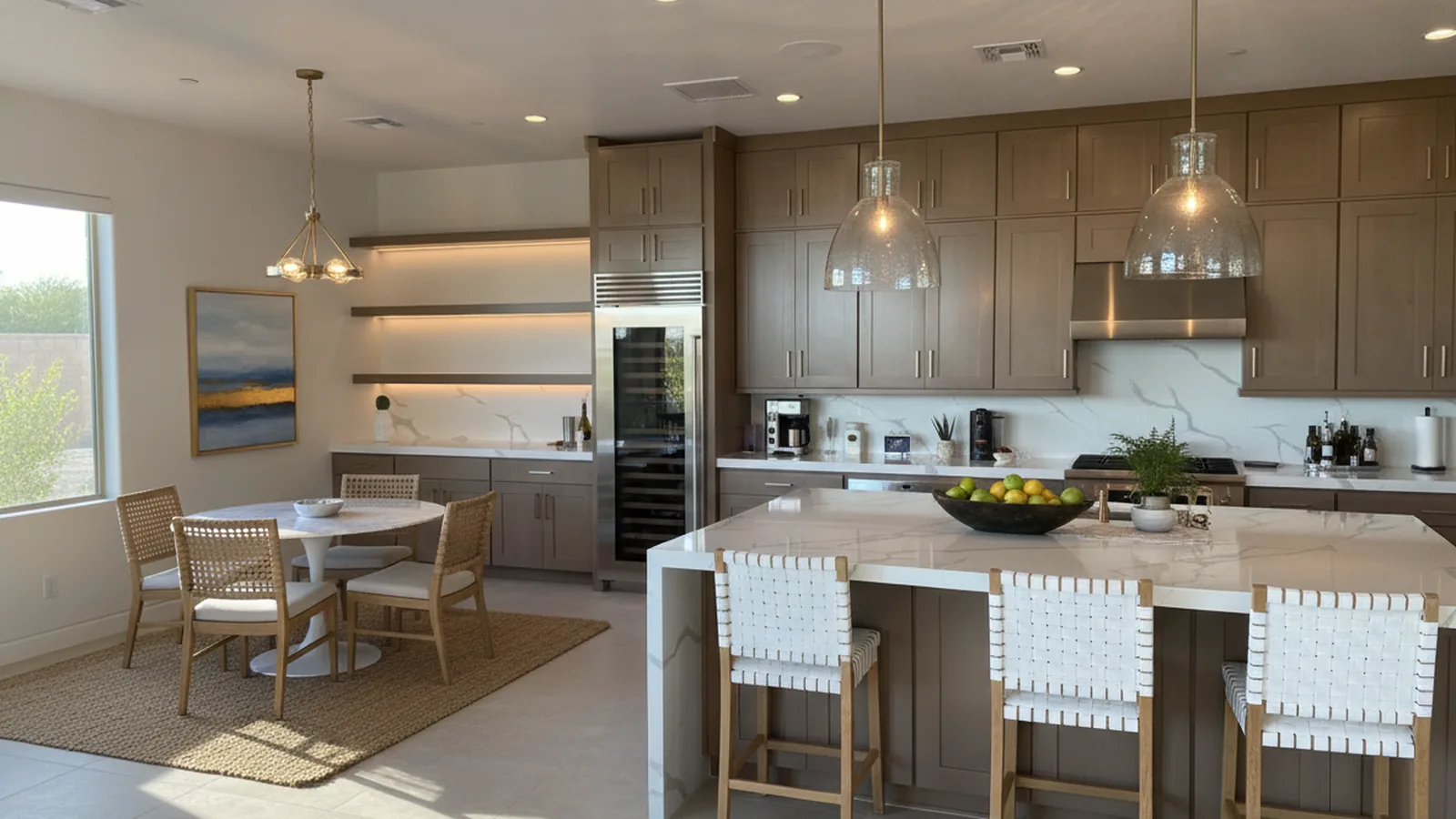
Quick answer: Taj Mahal engineered quartz is man-made quartz styled to imitate Taj Mahal quartzite, a natural stone. The engineered version is lower maintenance and usually costs less, while the natural stone has more depth and takes heat better. Either can work well, provided you know which one is written on your quote.
Key takeaways
- The name describes a look, so two “Taj Mahal” slabs from different suppliers can be entirely different materials.
- Engineered quartz skips sealing. Natural quartzite asks for it in exchange for better heat tolerance.
- In Arizona, direct sun and hot pans are harder on engineered quartz, while hard water is easy on both with the right cleaner.
- Get the material type and manufacturer in writing before you approve any slab.
What is Taj Mahal engineered quartz?
Taj Mahal engineered quartz is a manufactured countertop slab, built from crushed quartz bound with resin and pigment, and designed to resemble Taj Mahal quartzite. The real stone is quarried, commonly in Brazil, and is known for creamy white to soft beige tones with faint gray, taupe, or gold veining.
Engineered quartz is typically around 90 percent ground quartz, with resin and color making up the rest. A factory controls the pattern, so slabs come out consistent and a little more uniform than stone formed over geologic time. Because there is no industry standard for a Taj Mahal quartz, one brand’s version can look quite different from another’s. Treat the name as a style description.
Taj Mahal quartzite, Taj-style quartz, or a look-alike: which one is it?
Four different materials tend to get lumped under this search, and the paperwork on a slab identifies which one you have more reliably than your eyes can.
- Natural Taj Mahal quartzite. Hard natural stone with crystalline depth, no two slabs alike, and a price that reflects quarrying and a harder cutting job.
- Engineered quartz in a Taj-style color. A resin-bound slab with a controlled, repeatable pattern.
- Porcelain with a similar pattern. A dense ceramic slab that can mimic the look closely and shrugs off heat.
- Softer look-alike stones. Some stones sold under quartzite-style names are actually marble or dolomite types that etch more easily.
Three checks help. Ask for the material type and manufacturer in writing, since the name alone settles nothing. Look at several slabs from the same supplier, because natural slabs never match while engineered slabs from one production lot can look almost identical. Also watch how light moves across the surface: natural quartzite tends to show crystalline depth, while engineered quartz reads more even. No visual tell is foolproof, because good engineered quartz is convincing, so lean on the paperwork. A companion guide to Taj Mahal quartzite covers what the natural stone costs and which stones imitate it.
Where AZ Granite & Remodeling fits in
If you’d like help sorting a real quartzite from a good imitation, AZ Granite & Remodeling is one local option. It is a design-build remodeling contractor and in-house stone fabricator that has served the Phoenix Valley for over 20 years, with its shop at 1923 W. Cheryl Dr, Suite 2, Phoenix, AZ 85021. The team works with homeowners across North Scottsdale, Desert Ridge, Peoria, Sun City, Anthem, and the surrounding East and West Valley.
The materials list includes quartzite and engineered quartz (see the quartz countertops page), along with granite, marble, dolomite, porcelain, onyx, and natural quartz, and fabrication and installation happen in house. That lets you compare a natural Taj Mahal-style stone against an engineered one with one team instead of two, and put questions about edges, seams, and sealing to the people who will cut the slab.
The process is one-on-one with a designer, and the estimate is a free, no-pressure in-home visit. That matters for a cream countertop, because a warm stone reads differently under your own windows and next to your own cabinets than it does on a sample board. Bring photos, and be ready to say how you cook, how much sun the kitchen gets, and whether you’re willing to seal a stone now and then. Those three answers usually settle quartz versus quartzite faster than any brochure.
The team is rated 5.0 stars. A call is most useful for asking what Taj Mahal-style slabs, natural or engineered, are available for your project and what the fabrication would involve. Reach the shop at (602) 759-9000 or request an estimate.
How do the three options compare side by side?
Natural quartzite leads on depth and heat tolerance, engineered quartz leads on easy upkeep and consistency, and porcelain trades some stone-like depth for heat and stain resistance.
| Natural Taj Mahal quartzite | Taj-style engineered quartz | Porcelain look-alike | |
|---|---|---|---|
| Pattern | Unique to each slab, so you pick the actual slab | Consistent, and can repeat from slab to slab | Consistent, printed or through-body |
| Hot cookware | Tolerates heat well, trivets still wise | Resin can scorch or discolor, trivets needed | Very heat tolerant |
| Stains and etching | Depends on the stone, sealing needed | Nonporous, no sealing | Nonporous, no sealing |
| Direct sun | Stable color | Resin can discolor in prolonged sun | Stable color |
| Edges and corners | Hard, but can chip if struck | Durable, can chip if struck | Thin slabs can chip, so edge profile matters |
| Relative installed cost | Usually the highest of the three | Mid-range | Often comparable to quartz |
| Best fit | Cooks who want natural depth and will seal | Busy households wanting low upkeep | Sun-exposed or high-heat spots, with an experienced fabricator |
How do they hold up in an Arizona kitchen?
Heat, sun, and hard water account for most of the real-world difference in Arizona, and each material reacts to them differently.
A pan straight off the burner is the classic test. Natural quartzite and porcelain tolerate heat well, while the resin binder in engineered quartz can scorch or discolor under very hot cookware, so trivets are wise with all three.
People tend to underrate desert sun. Prolonged direct sunlight can fade or yellow resin-bound surfaces over time, which matters for a kitchen with big west-facing glass or a counter that runs out toward a patio. A separate guide on whether quartz countertops fade in the sun covers the details.
Valley water leaves mineral spots and scale around faucets and sink edges. A soft cloth and mild cleaner handle it on engineered quartz and on sealed quartzite, but acidic descalers can dull a sealer or etch natural stone, so pick a stone-safe cleaner. The Natural Stone Institute publishes care guidance for natural stone, and a warm cream tone tends to hide monsoon dust better than a dark counter would.
What does it cost, and what drives the price?
Natural Taj Mahal quartzite usually costs more installed than engineered quartz in a similar look, but slab choice, layout, and fabrication move the total more than the material name does.
Per-square-foot figures online vary widely and rarely match a specific slab, so treat them as a rough direction. Entry-level engineered quartz tends to sit toward the lower end of the market and natural quartzite toward the upper end, but the ranges overlap, and a premium engineered slab can cost more than an entry-level quartzite.
What pushes a quote up or down:
- Slab grade, origin, and availability. Rare or premium slabs cost more, and natural slabs are priced one by one.
- Square footage and waste. Matching veining across seams on a large island can require extra material.
- Edge profile and cutouts. Mitered edges, undermount sinks, and cooktop openings add fabrication time.
- Material difficulty. Dense natural stone takes more time and tooling to cut and polish.
- Removal and prep. Tearing out the old top and disconnecting plumbing add labor.
Ask any shop for an itemized quote that separates slab, fabrication, installation, and removal, so bids compare on equal terms. The only reliable number for your kitchen comes from a measured template and a written quote, which is why an in-person estimate beats any per-square-foot figure.
What should you check before approving a slab?
Five checks cover most of the risk: what the material really is, how it looks in your light, who builds it, and whether the contractor is licensed.
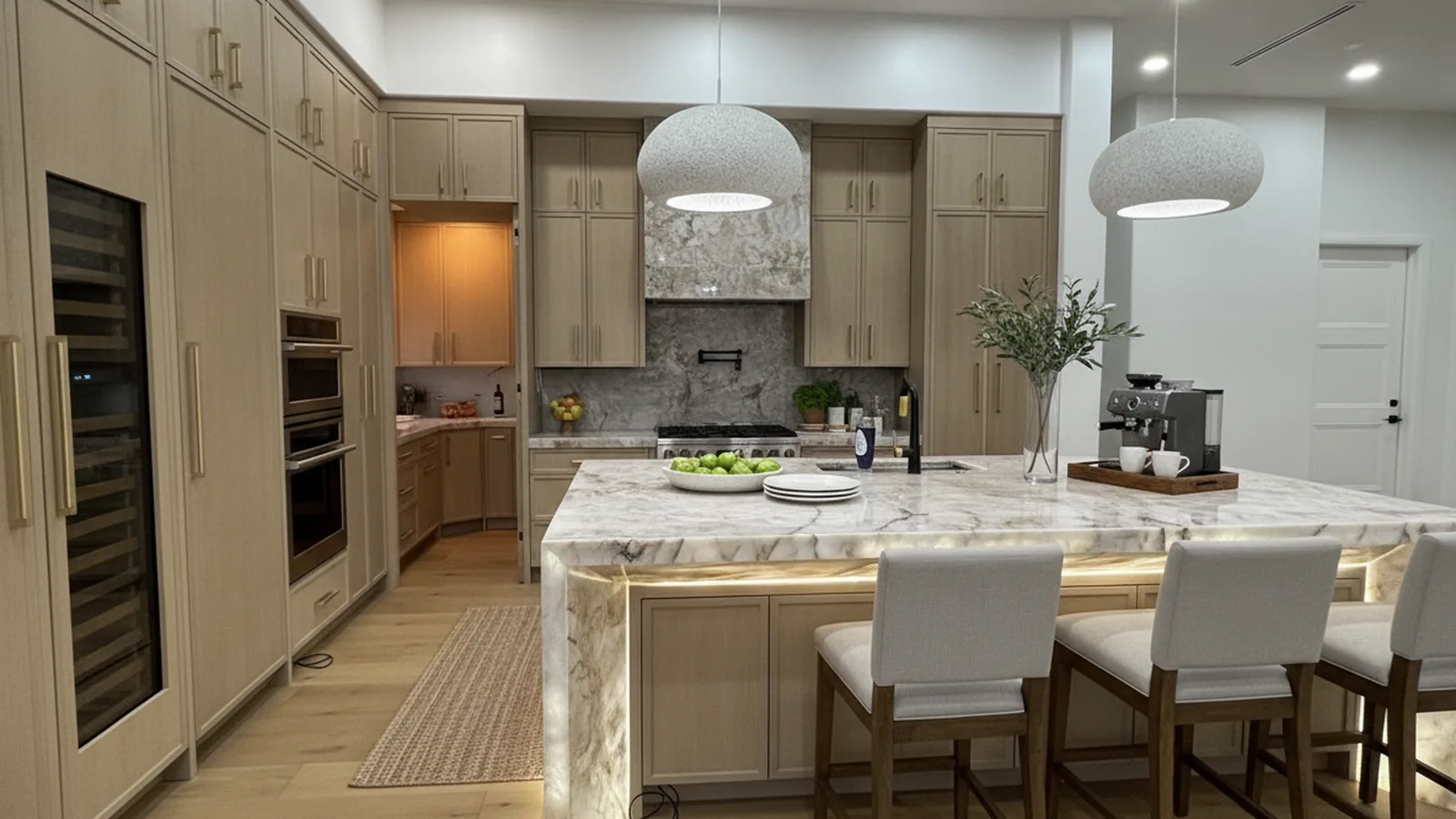
- Get the material in writing. The quote should name the material type (quartzite, engineered quartz, porcelain) and the manufacturer or quarry source.
- See the full slab. A four-inch sample can’t show veining, color shifts, or pits. For natural stone, choose the actual slab and have the seams planned on it.
- Judge it in your own light. Cream and taupe lean yellow or gray depending on the light, so hold a sample against your cabinets and flooring at different times of day.
- Ask who cuts and installs it. A shop that fabricates and installs its own work has fewer handoffs, and you know who to call if something needs adjusting.
- Verify the license. Check the contractor’s status with the Arizona Registrar of Contractors before you sign.
Frequently asked questions
Do I have to seal Taj Mahal quartzite?
Yes, plan on sealing it. Natural quartzite is usually sealed at installation and rechecked periodically, because even dense stone has some porosity. A simple water-drop test shows when it’s time: if water darkens the stone instead of beading, ask your fabricator about resealing. Engineered quartz is nonporous and needs no sealer.
Does Taj Mahal quartzite etch like marble?
Real quartzite usually resists etching far better than marble, but not every stone sold as quartzite behaves that way. Etching shows up as dull spots where acids like lemon juice or vinegar sat on the surface. Ask your fabricator to test an offcut of the exact stone you’re considering, since that answers it for your slab.
Can a Taj Mahal-look countertop go in an outdoor kitchen?
Engineered quartz usually shouldn’t. Prolonged Arizona sun is hard on resin binders, so natural stone or porcelain suits an outdoor kitchen better. A covered, shaded patio is a gray area, so ask your fabricator what they will stand behind for your exposure before you order anything.
Is engineered quartz safe to live with, given the silica warnings?
Generally yes, once installed. The concern is respirable crystalline silica dust created when quartz, quartzite, or other stone is cut, ground, or polished, which is why OSHA regulates silica exposure in workplaces. Ask any fabricator how it controls dust during cutting, because that is where the risk sits.
Can I use quartzite on the island and engineered quartz elsewhere?
Yes, mixing is common, and it’s a practical way to spend on the showpiece surface only. The challenge is undertone, since cream and taupe vary a lot between materials and brands. Compare actual slab samples side by side, in your own light, before committing to a split.
What cabinet and backsplash colors suit a Taj Mahal countertop?
Warm whites, soft greiges, and natural wood tones work well because they echo the stone’s cream and taupe undertones. Cool, blue-leaning whites can make the countertop look yellow by comparison. A simple, light backsplash lets the veining carry the room. Bring cabinet and flooring samples to any slab viewing.
Can I buy the slab myself and hire a fabricator?
Sometimes, but policies vary by shop. Many fabricators prefer to source the slab themselves so they can stand behind the whole result, and some won’t warranty a slab they didn’t select. Ask any shop for its policy in writing before you buy a slab on your own.
Is a Taj Mahal look practical for a bathroom vanity?
Yes, and a vanity is often the most affordable place to use a premium slab, because it needs so little stone. Small tops can sometimes come from offcuts, so ask your fabricator whether suitable pieces exist. Sealed natural stone and engineered quartz both handle bathroom moisture well, provided the sealing is kept up.
Ready to see Taj Mahal-style stone in your own kitchen?
Taj Mahal engineered quartz can be a smart, lower-maintenance way to get a popular look, and the natural stone earns its price for cooks who want depth and heat tolerance. Whichever you choose, get the material named in writing and see a full slab in your light before you approve it. If you want a second set of eyes, AZ Granite and Remodeling offers free, no-pressure estimates in homes across the Valley, and you can request one on the contact page.