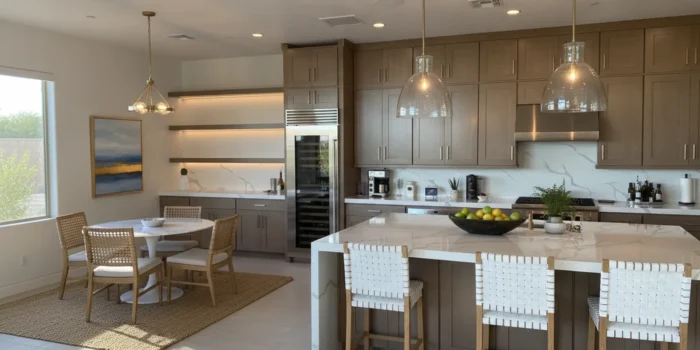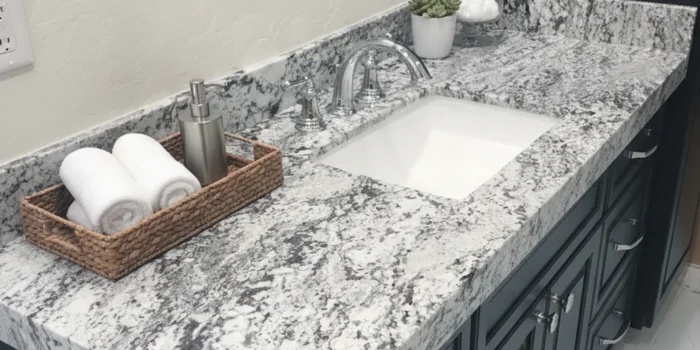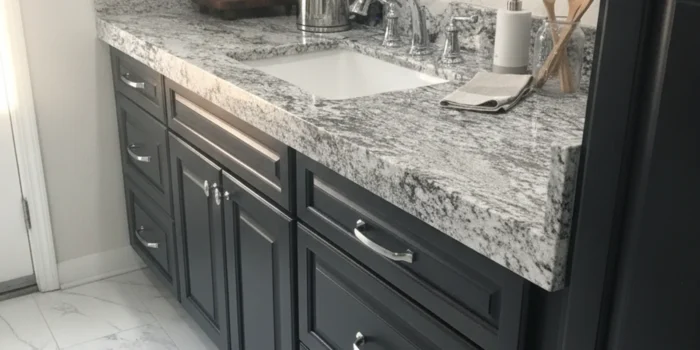
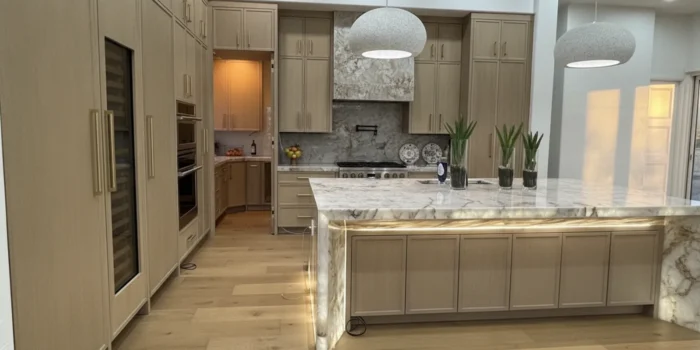
Shopping for granite countertops in Mesa, AZ usually starts with what it will cost and quickly picks up three more questions: which slab, which fabricator, and how long the kitchen will be torn up. The answers depend on your layout, the stone tier you choose, and who does the cutting and the install. This guide walks through each decision and its trade-offs, whether you end up hiring AZ Granite & Remodeling or someone else.
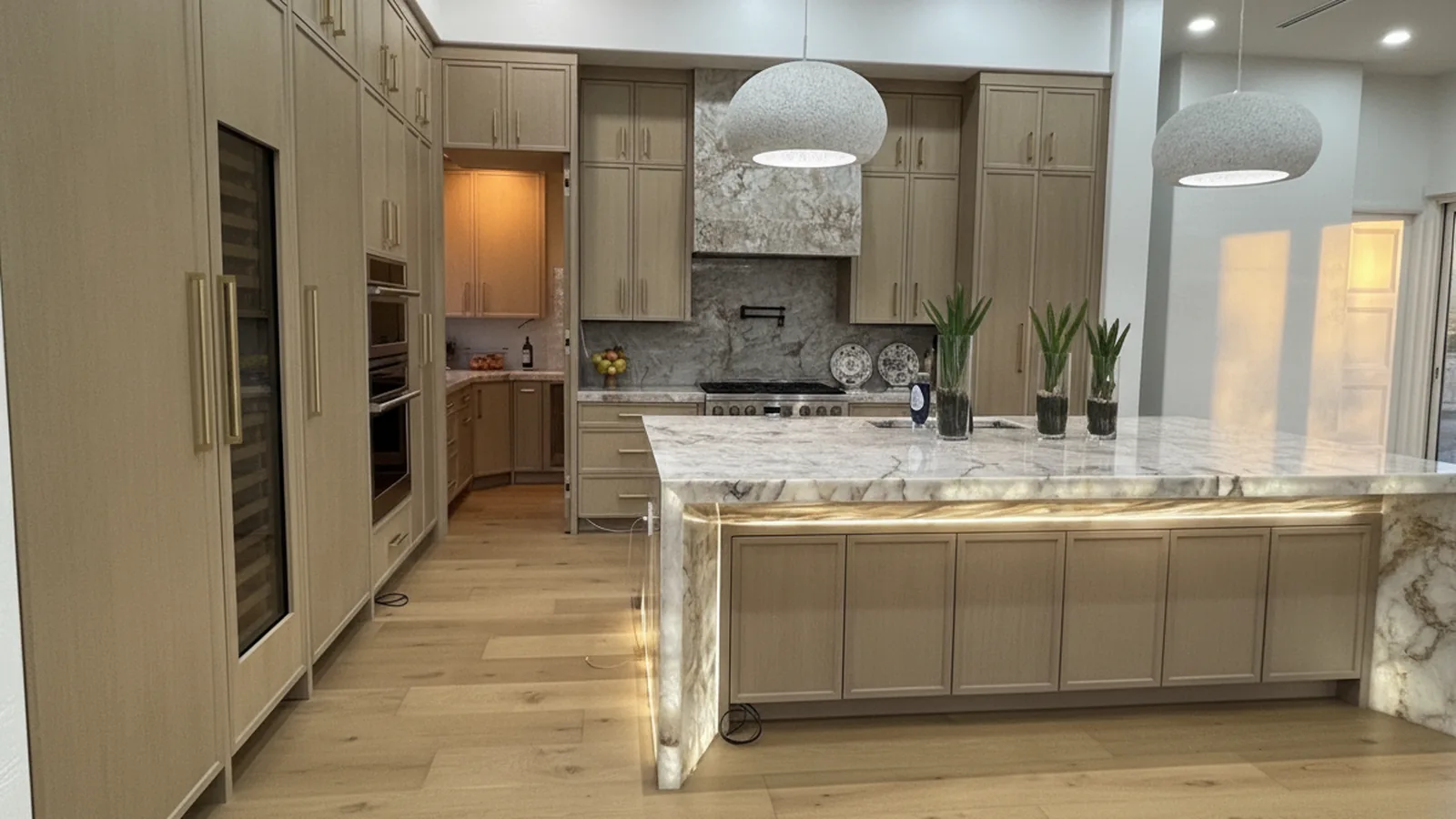
Quick answer: Granite countertops in Mesa, AZ commonly run about $45 to $120 or more per installed square foot, a market-wide ballpark and not a quote. The slab tier and layout complexity decide where you land, so pick the slab in person and get an in-home measure before you compare bids.
Key takeaways
- Slab tier and layout move the price more than the shop’s name does.
- Granite tolerates hot pans and strong sun, but it still needs occasional sealing.
- Choose the actual slab, not a sample, because no two pieces match.
- Compare bids on scope and inclusions: removal, cutouts, edges, and seams.
- A shop that fabricates and installs in house has fewer handoffs to go wrong.
What are granite countertops?
Granite countertops are cut and polished slabs of natural stone, made mostly of quartz and feldspar crystals, which is why they are hard and heat tolerant. Each slab is quarried, sliced into sheets roughly 9 to 10 feet long, and sold in price tiers based on color, rarity, and origin. A fabricator then templates your cabinets, cuts the stone to fit, and installs it.
One quirk worth knowing: in the stone trade, some banded or dark stones are sold as “granite” even though geologists classify them differently. That is usually fine in a kitchen, but ask what you are really buying, since it can change sealing needs. The Natural Stone Institute, the trade association for the natural stone industry, publishes selection and care guidance if you want a neutral reference.
How does buying granite in Mesa actually work?
Mesa has plenty of sellers, so the useful move is sorting them into three types, each with a different trade-off. The city’s mix of older tract homes and newer master-planned communities such as Eastmark also means kitchens vary widely, and older cabinet runs are more likely to be slightly out of square, which makes accurate templating matter.
- Big-box stores: Convenient and often package-priced, with a narrower slab selection. Measuring and installation are commonly handled by contracted crews, so ask who will actually show up.
- Stone yards: A wide selection, and you walk the inventory yourself. You typically hire a fabricator separately, which can mean two parties to coordinate.
- Full-service fabricators: Selection, cutting, and installation under one roof. Fewer handoffs, though quality and pricing vary by shop, so look at finished work.
Any of the three can work, depending on how much coordination you want to own.
Where AZ Granite & Remodeling fits for Mesa homeowners
AZ Granite & Remodeling is a design-build remodeling contractor and in-house stone fabricator in Phoenix, Arizona, which makes it a fit for homeowners who want one team handling design, cutting, and installation. The company has served the Phoenix Valley for over 20 years and is 5.0-star rated.
The countertop work happens in its own shop at 1923 W. Cheryl Dr, Suite 2, Phoenix, AZ 85021, the company’s only location. Service covers the Phoenix Valley, including North Scottsdale, Desert Ridge, Peoria, Sun City, and Anthem, plus the surrounding East and West Valley, where Mesa sits. If you are unsure whether your address is in range, ask when you call.
You work one-on-one with a designer who balances form and function, meaning how the kitchen looks and how it is used day to day. The shop handles custom fabrication and installation in house, and the estimate is free and no-pressure, so you can set it beside other bids before deciding anything. Granite is one option among several: the shop also works in marble, quartz, quartzite, dolomite, porcelain, onyx, and natural quartz, so you can compare surfaces with the same team. The granite countertops page covers the stone itself in more detail.
Typical projects include:
- Full kitchen or bathroom remodels where countertops are one piece of a bigger plan
- Countertop-only replacements in granite, quartz, quartzite, and other stone
- Smaller jobs such as vanity tops, using granite remnants
- Flooring alongside a remodel
It may not be the right fit if you only want the cheapest off-the-shelf top, or you have already bought a slab elsewhere. In that case, ask the team directly whether they can work that way. When you are ready, you can request a free in-home estimate.
How do granite, quartz, quartzite, and marble compare in the Arizona sun?
Granite is the stronger pick for heat, sun, and a natural look, while quartz wins on zero sealing and uniform color. The table below compares the four surfaces Mesa homeowners ask about most.
| Surface | Hot pans | Strong sun | Upkeep | Typical price tier |
|---|---|---|---|---|
| Granite | Tolerates well; trivets still wise | Does not fade | Seal occasionally; resists etching | Entry to high, by slab tier |
| Quartz (engineered) | Resin can scorch or mark | Some colors may yellow in prolonged direct sun | No sealing; non-porous | Mid to high |
| Quartzite | Tolerates well | Does not fade | Seal; some types can etch | Often above granite |
| Marble | Tolerates heat | Does not fade | Seal, and acids still etch it; shows hard-water marks | Mid to high |
For most Mesa kitchens the decision comes down to how much upkeep you will tolerate. If occasional resealing sounds fine, granite and quartzite give you natural variation no other kitchen shares. If you never want to think about sealing, quartz is easier, and a longer breakdown sits in this quartz vs granite guide for Arizona homes.
Sun deserves more weight than hot pans in this region. A west-facing slider can bake a counter for hours each afternoon, and natural stone does not fade, while some resin-bound quartz colors may yellow under prolonged direct sun. If your kitchen opens onto a bright patio, weigh that early.
What drives the price of granite countertops in Mesa, AZ?
Five things move the number inside that range: slab tier, amount of stone, edge profile, cutouts and seams, and removal work.
- Slab tier. Granite is priced in tiers by color, rarity, and origin. Common speckled neutrals sit at the entry tier, while exotic veined or blue stones sit at the top, and a premium slab can cost several times as much as a standard one.
- Stone quantity. Depending on the shop, you pay either for the slabs your layout consumes or for a per-square-foot rate that builds in waste. An island that barely spills onto a second slab can cost more than its square footage suggests.
- Edge profile. Simple eased edges are the baseline. Ogee, bullnose, and mitered waterfall edges add labor and stone.
- Cutouts and seams. Undermount sinks, cooktops, and faucet holes each take shop time, and a full-height backsplash adds area.
- Removal and plumbing. Tearing out old tops and disconnecting plumbing is sometimes included and sometimes billed separately.
The lowest bid often leaves one of these out, so line up two or three quotes on the same itemized scope before you judge them. For smaller jobs like a vanity top, bar top, or laundry counter, remnants cut from leftover pieces can lower the cost sharply because you pay only for the piece. To trim a larger budget, see this guide to saving on granite without regrets in Phoenix.
How do you pick a slab you will still like in ten years?
Walk the inventory and choose the exact slab, not a sample tile, because granite shifts in pattern and tone from one slab to the next and even across a single slab. Ask to have your slab tagged or photographed so the pieces for your kitchen come from the one you approved.
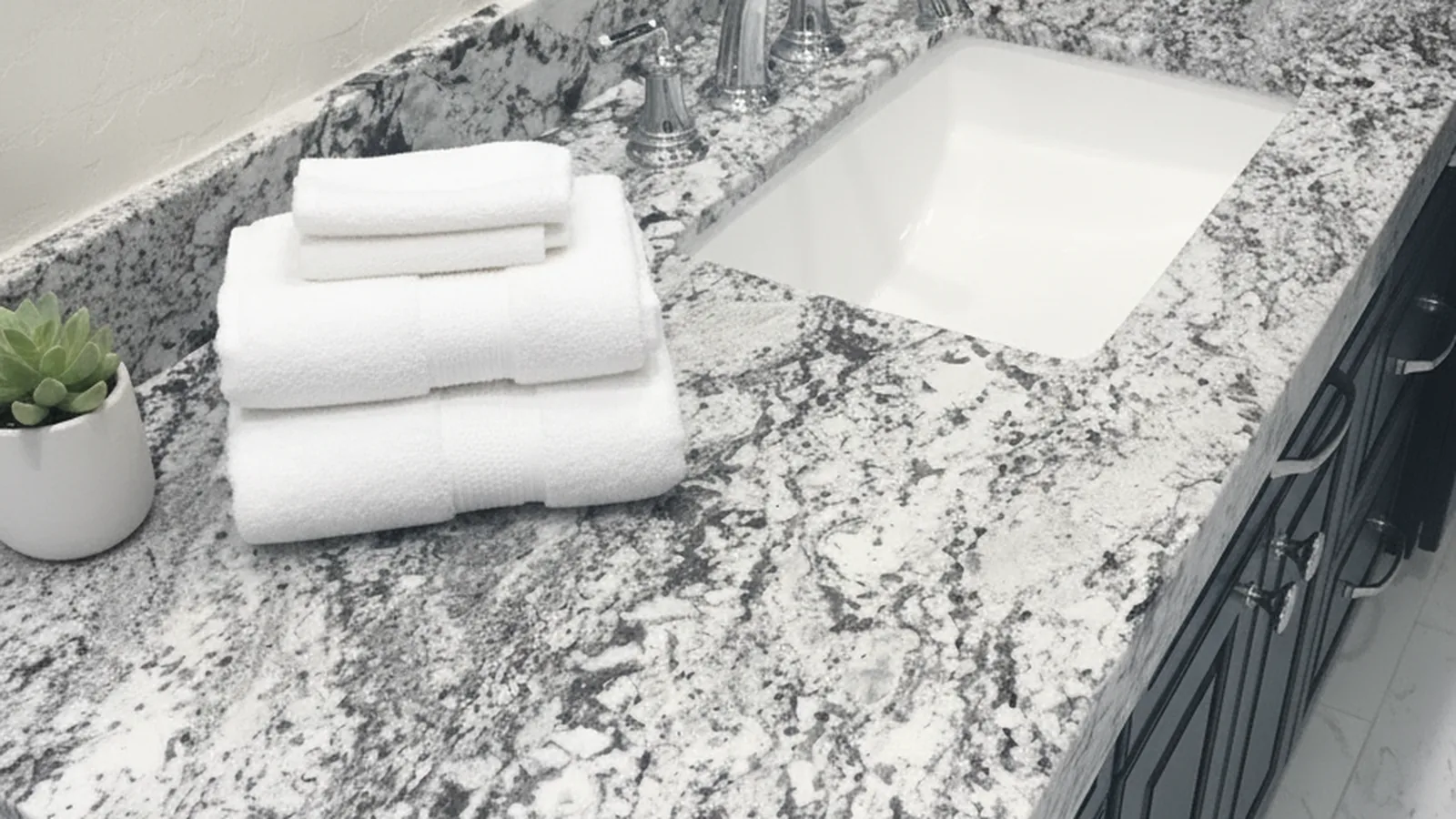
Then check a few things in person:
- Light. View the stone near a window, since Valley sun makes it read lighter and flatter than warehouse lighting does.
- Finish. Polished stone looks glossy and shows water spots, while honed or leathered finishes hide hard-water spotting and fingerprints better.
- Flaws. Natural veins and small pits are normal, but a long crack-like fissure crossing the span near a sink cutout deserves a direct question.
- Thickness. 3 cm is common for kitchens, and thinner tops are usually supported underneath, which can change your edge options.
- Color. Very dark polished stone shows monsoon dust and mineral rings, while mid-tone speckled patterns are forgiving.
What should you ask a fabricator before you sign?
Ask who actually templates, cuts, and installs your stone, because that decides how many handoffs sit between your measurement and the finished top. Then work through the rest:
- Who fabricates? An in-house shop controls its own schedule and quality, while a reseller sends your job to a third party.
- Who installs? Employees or subcontractors, and whether the same crew takes the template.
- What is included? Removal of old tops, sink cutouts, edge profile, backsplash, sealing, and plumbing disconnects. Get it itemized.
- Where will seams land? Ask for a layout drawing before cutting starts.
- What does the warranty cover? Ask for it in writing, along with how callbacks are handled.
- Is the license current? Look up the contractor on the Arizona Registrar of Contractors site and ask for proof of insurance.
- Ask to see photos of recent finished jobs and a few references.
A shop that answers these plainly can usually back its work. Hedging on the first two questions is a flag worth noticing.
What happens between measuring and install day?
Expect three stages, template, fabrication, and installation, in that order, with the template taken only after your cabinets are in and you have chosen your sink and cooktop. The template is a precise record of your cabinet run, so changing the sink or layout afterward can mean starting over. Fabrication happens in the shop, then the crew sets the stone, joins any seams, and caulks and seals. Timing depends on slab availability and the shop’s schedule, so ask for estimated dates in writing rather than assuming. Before install day, clear the counters and the cabinet under the sink.
How should you care for granite in Valley water and sun?
Wipe daily with warm water and a pH-neutral stone cleaner, and reseal when a drop of water left on the stone soaks in and darkens it after 10 or 15 minutes. How often that happens depends on the stone, so test rather than following a calendar.
Hard water is a familiar nuisance in the Valley. The USGS Water Science School explains that hardness comes from dissolved calcium and magnesium, which is what leaves white rings around faucets and spots on polished stone. Wiping the area dry after use and avoiding acidic cleaners such as vinegar or lemon, which can dull sealer and some finishes, handles most of it. Granite tolerates heat well, but a trivet for oven-hot cookware costs little and spares the stone stress, especially near seams.
Frequently asked questions
How do I estimate how much granite I need?
Multiply each counter run’s length by its depth, which is typically about 25 inches for base cabinets, then add islands, peninsulas, and any backsplash, and convert to square feet. A typical kitchen lands somewhere around 30 to 50 square feet. Treat that as a budgeting figure only, since the fabricator’s template, not a tape measure, sets the real number.
Can I use granite in an outdoor kitchen in Mesa?
Yes, granite is a common choice for outdoor kitchens because it does not fade and tolerates heat. Choose a lighter color or a honed or leathered finish, since dark polished tops can get very hot to the touch in direct summer sun, and ask the installer about sealing for outdoor use.
Will a seam show, and can I avoid one?
Usually only up close. A well-placed seam reads as a thin, tight line when the fabricator matches pattern and color, though a long run or an L-shaped kitchen often needs one because slabs come in fixed lengths. Ask where seams will fall and try to keep them away from the sink and cooktop.
Can I keep my existing sink and cooktop?
Often yes, but the fabricator needs the exact model before cutting, because each cutout is made from that unit’s template. Undermount sinks attach to the underside of the stone, so a new top is also the easiest moment to replace an aging sink. Have the model numbers or the units themselves ready for the template visit.
Do I need a permit in Mesa to replace countertops?
Swapping countertops alone usually does not call for a permit, but moving plumbing, gas lines, or electrical often does, so confirm with the City of Mesa before work starts. Ask your contractor which case applies to your scope and get the answer in writing.
Does granite add resale value?
Sometimes, but nobody can promise a dollar-for-dollar return at sale, because buyers judge the kitchen as a whole. Granite is a familiar, buyer-friendly material, and if you may sell within a few years, a mid-tier slab in a neutral color is usually the safest choice.
How long does granite last?
With reasonable care, granite can outlast the rest of the kitchen. The stone itself rarely wears out; the parts that need attention over the years are the sealer, the caulk around the sink and backsplash, and any seam adhesive. A chipped edge can often be repaired, so call a stone professional before assuming you need a new top.
Is it cheaper to buy a slab myself and hire an installer?
Sometimes, but it moves the risk of flaws and breakage onto you. If a slab cracks during cutting or hides a defect, who covers it? Many fabricators prefer to supply their own stone for that reason, so ask any shop up front whether it will fabricate a slab you bought elsewhere and what warranty applies.
Ready to price out granite countertops in Mesa, AZ?
Two or three written, itemized scopes will tell you more than any per-foot number. If you want one of them to come from a design-build team that cuts its own stone, request a free, no-pressure in-home estimate, call AZ Granite and Remodeling at (602) 759-9000, or email veny@azgranite.us.