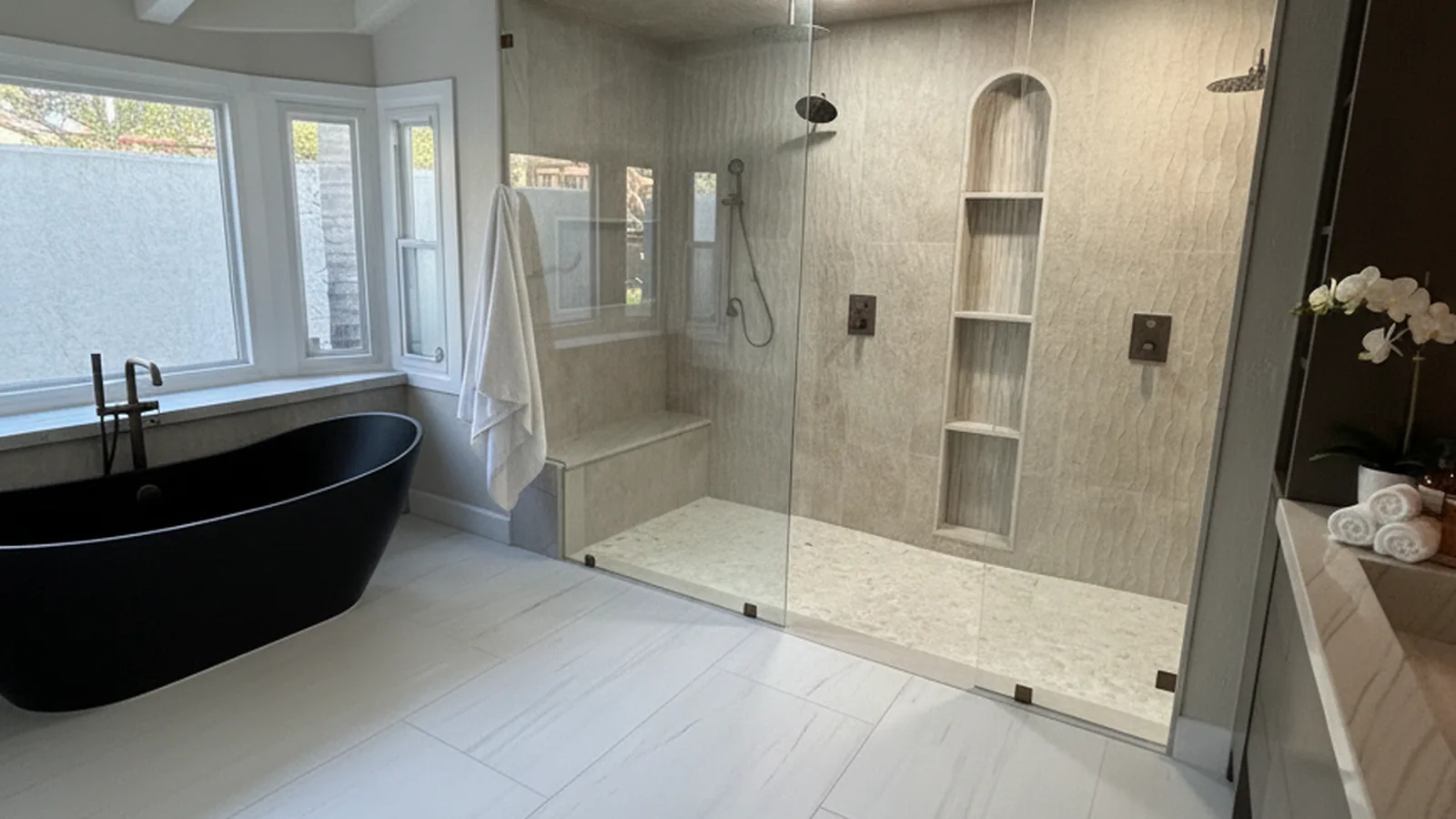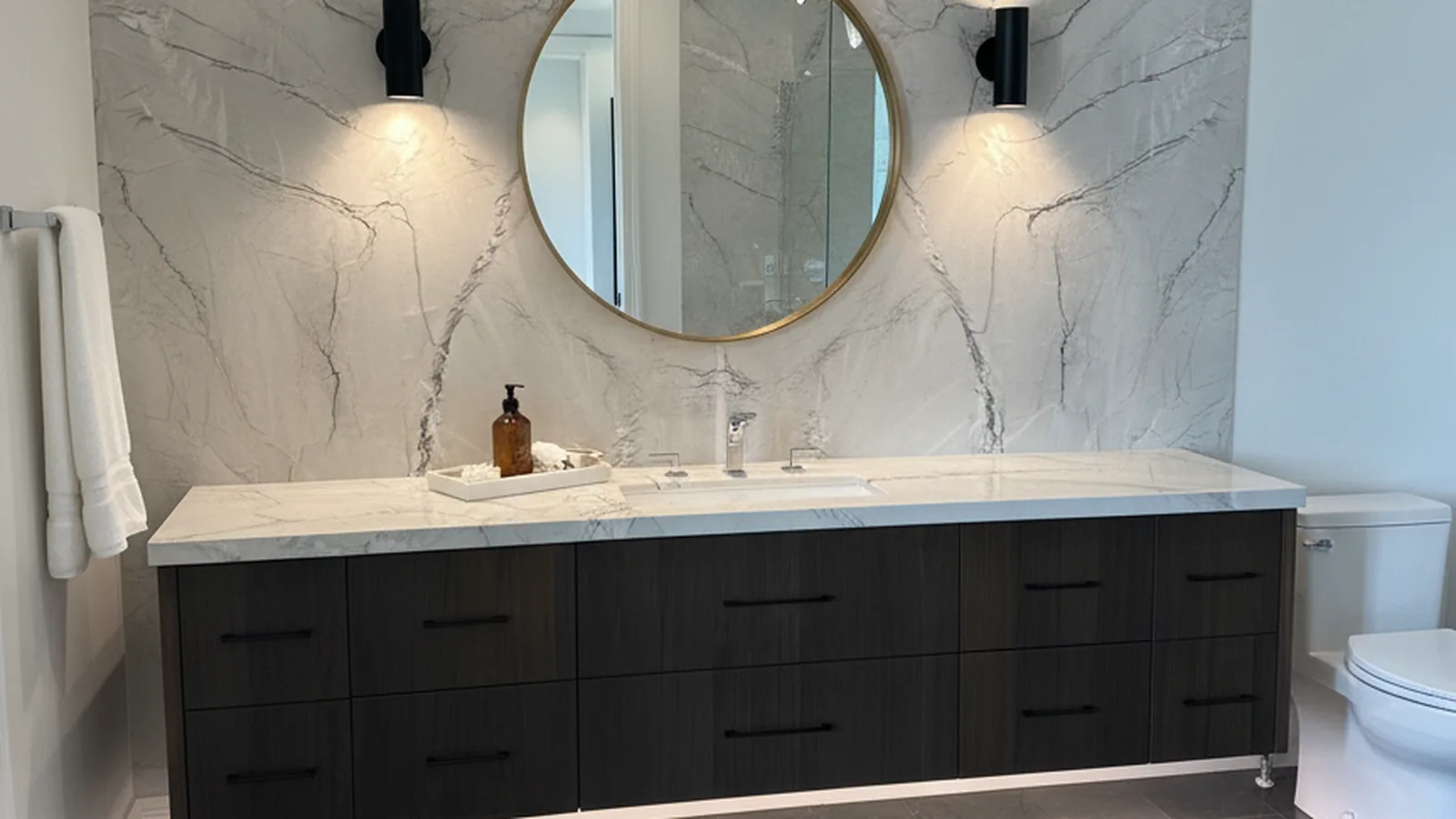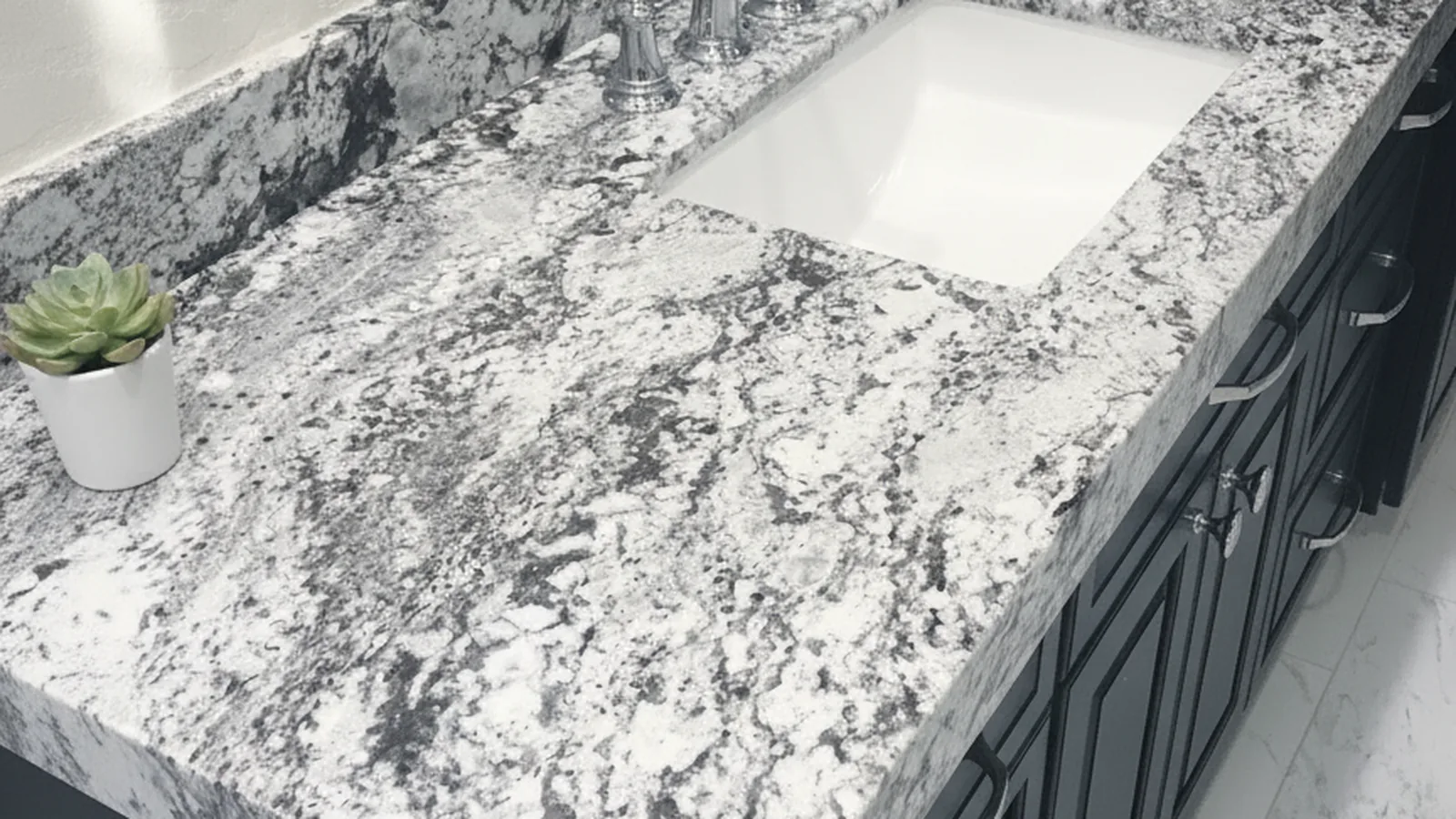
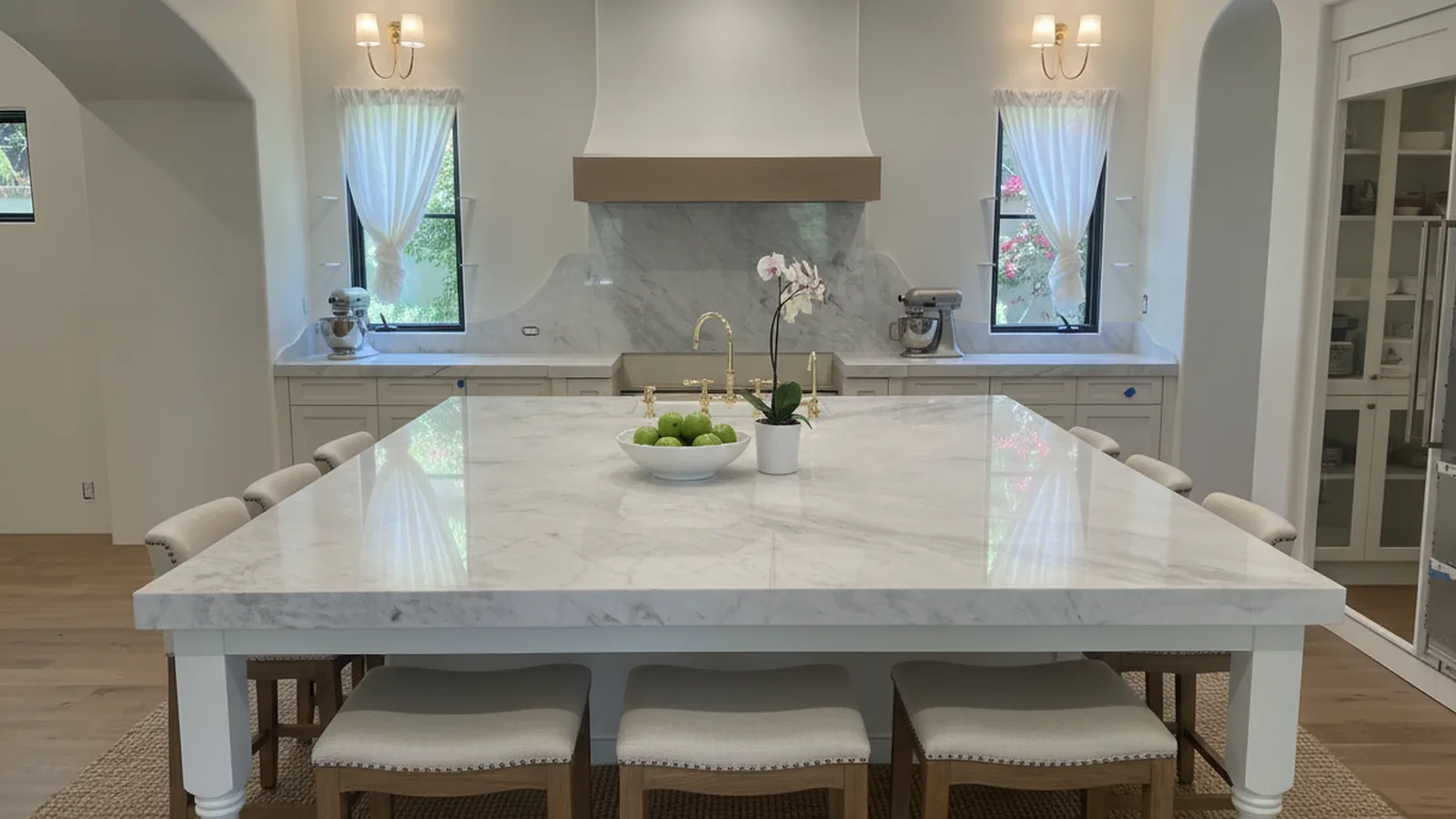
Most people searching for marble slabs are in one of two places. Either they’re deciding whether marble belongs in their home at all, or they’re about to walk a stone yard and want to avoid an expensive mistake. This guide covers both: what a slab actually is, how to judge one in person, what moves the price, and how marble behaves in Arizona homes with hard water and strong sun.
Quick answer: A marble slab is a single large, polished sheet of natural marble that a fabricator cuts into countertops, vanity tops, or wall panels. It suits homeowners who can live with sealing, a few etch marks, and a visible patina. If that sounds stressful, a marble-look quartzite, dolomite, or quartz gets you most of the appearance with fewer worries.
Key takeaways
- Choose the exact slab, because two slabs sold under the same name can look very different.
- Rarity sets the price first, and fabrication details add to it afterward.
- Marble is easiest in bathrooms, and hardest in a hard-working family kitchen.
- Weigh the look-alike stones before you commit, since several get close for less upkeep.
- Get warranty terms in writing before you buy slabs separately from the person cutting them.
What are marble slabs?
Marble slabs are large sheets of natural marble, cut from quarried blocks and polished at a mill, that a fabricator then turns into countertops, vanity tops, shower walls, or fireplace surrounds. Marble is limestone that recrystallized under heat and pressure, and the veining comes from mineral impurities like clay, iron oxide, and graphite that were folded through the stone as it formed.
Slabs are sold whole, usually 2 or 3 centimeters thick. Two centimeters is common for vanity tops and wall work. Three is the usual choice for kitchen counters because it needs less support underneath and allows a cleaner edge.
Most of what people love and dislike about marble comes from its chemistry. It is mostly calcium carbonate, so it is softer than granite and reacts with acids. Slabs cut one after another from the same block are numbered in sequence, which is how a fabricator can lay them side by side so the veining flows across a seam.
Types of marble slabs you’ll see, and how they differ
Most marble slabs on a rack fall into a handful of families, and the family sets both the look and the price tier.
- Carrara: white to blue-gray with soft, feathery veining. The most widely available and generally the most affordable.
- Calacatta: a brighter white ground with bold, widely spaced veins in gray or gold. Rarer, and priced that way.
- Statuario: bright white with strong gray veining, landing between Carrara and Calacatta in drama.
- Crema Marfil: warm beige and nearly uniform, for people who want marble’s glow without bold veins.
- Nero Marquina: deep black with thin white veins, often used as an accent rather than across a whole kitchen.
Treat these names as a starting point. Suppliers use “Calacatta” and “Statuario” loosely, so judge the slab, not the label. Grading is just as loose: many suppliers sort slabs by visible fill, fissures, and color consistency, but there is no universal scale, so ask what a given supplier’s grade actually means.
Where AZ Granite & Remodeling fits into buying marble slabs
AZ Granite & Remodeling is a design-build remodeling contractor and in-house stone fabricator that has served the Phoenix Valley for over 20 years. Its materials list includes marble alongside granite, quartz, quartzite, dolomite, porcelain, onyx, and natural quartz. That range matters here, because the right answer for a given kitchen is sometimes a different stone than the one you walked in wanting.
The design-build setup has practical effects. You work one-on-one with a designer who can test marble against how you actually cook, clean, and entertain before any slab is chosen. Fabrication and installation are done in house, so one team answers for the cut, the seams, and the fit. Marble is also softer and less forgiving to cut than granite, which makes the shop decisions (where seams fall against the veining, how a sink cutout sits, how an overhang is supported) matter more than they would on a harder stone.
Because the same company handles kitchen and bathroom remodeling, flooring, and countertops, the slab gets chosen alongside cabinets, backsplash, and fixtures instead of in isolation. That avoids a common problem: a gorgeous slab picked first, and then a cabinet layout that puts a seam across the most visible stretch.
If a conversation shows that marble will frustrate you, we would rather say so and show you quartzite or dolomite that read as marble from across the room. The marble page covers marble as a material in more detail.
Estimates are free and no-pressure, and they happen in your home, which is especially useful with marble because light changes it. A slab that looks cool gray under shop lighting can read warmer or whiter next to your cabinets and window orientation, and desert sun is strong enough to show the difference. You can request an estimate and bring your questions.
Ask us what you would ask anyone: how slabs are sourced, whether you can approve the exact slab before it is cut, and how seams will be laid out. Those are fair questions for any fabricator, ours included, and the estimate visit is the right time to ask. Push for specific answers.
How to inspect a marble slab before you buy it
Inspect the actual slab, in person, before any money changes hands, because photos and sample chips hide the things that cause regret. Work through these in order:
- View it upright, in daylight. Yard lighting flatters polish, so step to a doorway or window and see the true color and how the veining reads from several feet back.
- Check fissures against the layout. Hairline natural cracks along veins are normal, but one running through where a sink or cooktop opening will go is a risk. Ask the fabricator to lay out the cuts before you commit.
- Ask about fill and backing. Many slabs have resin-filled pits and a mesh backing to stabilize them. That is common practice, so ask how much fill there is and look at it in raking light for color mismatch.
- Confirm thickness and flatness. A slab that varies in thickness or bows will cause uneven seams and edge trouble.
- Buy sequential slabs. If the job needs more than one, slabs from the same block, in order, let the veining flow across a seam.
- Tag the exact slab. Get lot and slab numbers in writing, or photograph the tag, because “one like it” will not match.
If you can, bring your fabricator to the yard. They will spot layout problems in thirty seconds that you would not notice until template day.
Marble vs. quartzite, dolomite, quartz, and porcelain
Five materials can deliver the marble look, and each one makes a different trade-off.
| Material | Acid etching | Heat and sun | Pattern | Best fit |
|---|---|---|---|---|
| Marble | Etches readily; sealer helps with stains only | Fine indoors; polished surfaces weather outdoors | Natural, varies slab to slab | Vanities, baking stations, lower-traffic kitchens |
| Quartzite | Usually resists, but verify the specific stone | Handles heat and UV well | Natural, many slabs resemble marble | Busy kitchens, areas near outdoor living |
| Dolomite | More resistant than marble, not immune | Handles indoor heat well | Natural, often soft veining | Kitchens that want the marble look with fewer worries |
| Quartz | Does not etch | Resin binder, so use trivets and limit direct sun | Engineered and repeatable | Households that want a predictable look |
| Porcelain | Does not etch | Strong heat and UV tolerance | Printed or through-body, consistent | Outdoor kitchens, shower walls, large wall panels |
Be careful with quartzite: some stones sold as quartzite are actually softer marble or dolomite, so ask for the stone’s geological name and request a sample you can test. A drop of lemon juice left for a few minutes will dull marble but leave true quartzite alone. Test the sample, never the finished counter.
How marble slabs hold up in Arizona homes
Marble holds up structurally in Arizona, but its surface changes, mostly because of hard water and acids. Valley tap water leaves a mineral film and spotting around faucets and on vanity tops. Acids from lemon, wine, vinegar, and many bathroom cleaners cause etching, which is a dull spot where the acid dissolved a thin layer of stone. Etching is not a stain, so a sealer does little to prevent it. A sealer buys you time to wipe up spills before they soak in.
Finish is your best lever. Honed marble hides etching far better than polished, because there is no mirror shine to break. Polished shows every dull spot, and leathered sits in between.
Sun and dust matter too. Marble in a bright south-facing room is fine, but polished marble outdoors in full desert sun and heat will weather and dull, so outdoor kitchens usually call for granite or porcelain. Monsoon dust is mildly abrasive, so wipe grit away instead of dragging it across a polished top.
For routine care, the Natural Stone Institute, the industry’s trade association, publishes guidance on caring for natural stone. The standard advice is a pH-neutral cleaner and prompt wipe-ups, and avoiding vinegar or citrus-based sprays.
Where marble slabs make the most sense in a house
A bathroom vanity is the easiest place to start with marble, and a busy kitchen is the hardest. Vanities see few acids, and a vanity top needs only a fraction of a slab, which makes it a lower-cost way to enjoy a rare variety. Powder rooms, fireplace surrounds, and wall panels are similarly forgiving.
In kitchens, a common compromise is marble on the island or a baking station, with a tougher stone on the perimeter where the sink and cooktop live. Whole-kitchen marble works for households that cook gently and accept a patina. If each etch mark would bother you, choose a different stone and enjoy your weekends.
What drives the price of marble slabs
Rarity sets the base price of a marble slab, and then every step after the yard adds to it. Online per-square-foot figures are useful for orientation only, because these factors move the total:
- Variety and vein pattern: common Carrara-type stone sits at the lower end of marble pricing and can overlap with mid-range granite or quartz, while rare Calacatta and Statuario can run several times higher for the same footprint.
- Thickness: 3 centimeter slabs cost more than 2 centimeter slabs, though they may need less substrate work.
- Yield and waste: vein matching and a careful layout use more of the slab, so ask whether you pay for the whole slab or only the square footage used.
- Finish and edge: honing or leathering adds a step, and elaborate edge profiles add labor.
- Cutouts and seams: undermount sinks, cooktops, and waterfall edges all add fabrication time.
- Installation: removing old tops, reinforcing cabinets, and disconnecting plumbing often sit outside the stone price.
No honest total exists until someone measures your space and sees the slab, which is why layouts and a written, itemized quote matter more than any rule of thumb.
Buying marble slabs yourself or through a fabricator
You can buy marble slabs three ways: from a stone yard or distributor, online, or bundled through a fabricator or design-build contractor. Each shifts who carries the risk.
- Stone yard or distributor: you see the real slab and may avoid some markup, but you coordinate delivery to the shop and own the selection decision.
- Online: photos can be color-adjusted, so ask for a video of the exact slab with its tag number in frame.
- Through a fabricator: pricing is bundled and one party is accountable, but the quote should still break out slab, fabrication, edges, cutouts, and install.
Ask who warrants the stone before you buy slabs on your own. Some fabricators will not cover cracks in material they did not supply, and a yard’s return policy often ends once a slab is cut. Look up any contractor’s license on the Arizona Registrar of Contractors site before signing, and get everything itemized in writing.
Frequently asked questions
How many marble slabs does a typical kitchen need?
Most kitchens need one to three slabs. A full slab is roughly 9 to 10 feet long and 5 feet wide, around 50 square feet, though sizes vary by supplier. A small galley may fit on one slab, while a large island plus perimeter commonly takes more. Vein matching and seam placement raise the count, so ask for a layout before you buy.
How often should marble be sealed?
Once a year is a common starting point, but test instead of guessing. Drip water on the surface, and if it darkens the stone and soaks in rather than beading, it is time to reseal. Remember that a sealer slows staining, not etching, so it will not stop acid marks.
Can marble slabs be used in a shower?
Yes, with sealing and realistic expectations about upkeep. Marble is widely used for shower walls and floors, but constant water and hard-water minerals leave film and spotting. A honed finish helps on floors, since polished marble gets slippery. Ask the installer how waterproofing behind the stone is handled.
What happens to the leftover pieces of a slab?
It depends on the fabricator and on how the job was priced, so ask before the order is placed. Many projects use only part of a slab, and offcuts can often become a backsplash, a windowsill, a shelf, or a small vanity top.
Does marble crack easily?
It can, but usually at weak points rather than across open surface. The typical trouble spots are narrow stone beside a sink or cooktop cutout and overhangs without support. Good layout and proper support underneath prevent most of it.
How long does it take from picking a slab to installation?
It depends on slab availability, the shop’s schedule, and project scope, so get a timeline in writing. The sequence is consistent: choose and tag the slab, template once the cabinets are in place, fabricate, then install. Marble that has to be ordered in takes longer than stone already in stock.
Can I put a hot pan on marble?
Briefly, yes, but use a trivet anyway. Marble tolerates heat better than resin-bound quartz, yet a sudden extreme temperature change can stress natural stone, and heat can damage the sealer. A trivet costs far less than a repair.
Does AZ Granite & Remodeling serve my part of the Valley?
AZ Granite & Remodeling serves the Phoenix Valley, including North Scottsdale, Desert Ridge, Peoria, Sun City, and Anthem, plus the surrounding East and West Valley. If you are unsure whether your address is in range, call and ask, since the in-home estimate is where the project starts.
Choosing marble slabs with eyes open
Buy marble slabs in person, with a clear idea of how the room will be used and the warranty terms on paper. If you love the stone and can live with a patina, marble is one of the great natural surfaces. If the first etch mark would ruin your week, a harder look-alike is the smarter buy.
AZ Granite & Remodeling is at 1923 W. Cheryl Dr, Suite 2, Phoenix, AZ 85021. Call (602) 759-9000, email veny@azgranite.us, or request a free in-home estimate to talk through marble and its alternatives for your home.