You’re probably here because of a dark ring where a glass of water sat, a splash of cooking oil that wouldn’t wipe clean, or a fabricator who told you new counters need sealing. Either way, a search for a countertop granite sealer turns up a wall of bottles that all promise protection, and the labels don’t make the differences obvious.
The short version: most granite wants a penetrating sealer, applied only when the stone tells you it’s needed. The right product depends on your slab, your finish, and, here in Phoenix, Arizona, on a few local quirks like heat and hard water. This guide covers the types, the test, the schedule, the mistakes, and rough cost.
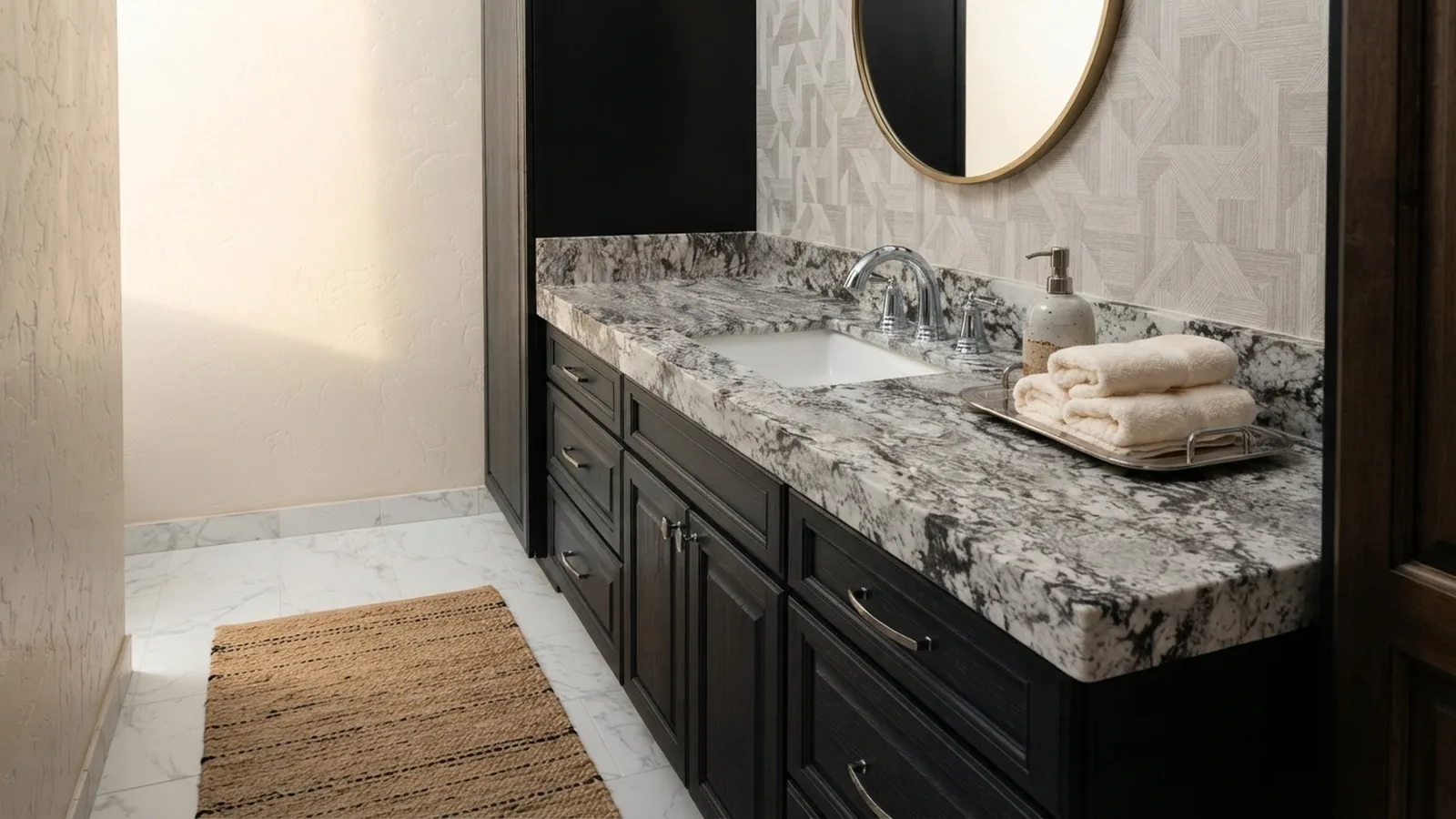
Quick answer: Choose a penetrating (impregnating) sealer labeled for natural stone, and apply it only after a water-drop test shows your granite darkening. Skip surface coatings. Dense, dark, polished slabs can go years between coats, while light or honed granite may need attention much sooner.
Key takeaways
- Finish and color decide porosity. Polished, dark, fine-grained granite absorbs least, and honed, leathered, light, or coarse-grained stone absorbs most.
- A sealer buys wipe-up time. It won’t stop scratches, chips, or heat marks, and it can’t lift a stain that’s already in.
- Topical coatings tend to scratch and haze, so penetrating products are the default for kitchen counters.
- Arizona adds two wrinkles: apply on a cool surface, and expect hard-water film that sealing makes easier to wipe but never prevents.
- The product costs little. The expensive mistakes are the wrong type, the wrong cleaner, and sealing over a stain.
What is a countertop granite sealer?
A countertop granite sealer is a liquid treatment that soaks into the stone’s tiny pores and makes them resist water, oil, and food dyes. Think of it as a repellent inside the stone, not a film on top of it. Granite is a dense igneous rock, mostly quartz and feldspar, so it’s among the tougher natural surfaces for a kitchen. It’s also not completely non-porous. Gaps between mineral grains vary a lot from slab to slab, and a sealer slows how fast liquid wicks into them, which gives you minutes to wipe up instead of seconds.
That’s the whole job. A sealer won’t protect against scratches, chipped edges, or heat. It also isn’t an etching defense, but granite rarely etches anyway, because quartz and feldspar shrug off lemon juice and wine. Etching is mostly a marble and limestone problem.
One catch: some stones sold as granite are technically gneiss, schist, or other rock that trades under the same name. These can be noticeably more absorbent than true granite, and they’re the slabs most likely to surprise you with a stain. If you’re not sure what you have, ask the fabricator or stone yard to identify it.
Does your granite actually need sealing?
Possibly, and a two-minute test answers it better than any calendar. Four things push a slab toward needing a sealer:
- Light color, coarse grain, or heavy veining, all of which tend to absorb more than dark, fine-grained stone
- A honed or leathered finish, which leaves the surface more open than a polish
- Years of cleaning, which slowly wear down whatever sealing was applied
- A slab that was never sealed at all, which is more common than people assume
To check, put a few drops of water in several spots, including next to the sink and the cooktop, and leave them 10 to 15 minutes. If the water beads and the stone keeps its color, the seal is working. If a spot darkens, that area is absorbing and it’s time. A drop of cooking oil is the tougher version, because oil soaks in faster than water, so an oil spot that darkens within a few minutes means the stone is under-protected.
Let the test set your schedule, not a bottle’s marketing.
Where AZ Granite & Remodeling fits in a sealer decision
AZ Granite & Remodeling is a design-build remodeling contractor and in-house stone fabricator that has served the Phoenix Valley for over 20 years, and we’re 5.0-star rated by Arizona homeowners. Our shop is at 1923 W. Cheryl Dr, Suite 2, in Phoenix, AZ, and we work with granite, marble, quartz, quartzite, dolomite, porcelain, onyx, and natural quartz. That range matters here, because the right sealer depends on the stone, and a fabricator who handles all of them sees how each one behaves.
Because we cut and finish the stone ourselves, the people advising you work where the slab is handled. That helps with a sealer question. They can tell you whether a slab is dense or open-grained, which finish you’re looking at, and where fissures or open veining might collect liquid. If you’re choosing new counters, that conversation happens early, with a designer you work with one-on-one, instead of after install day when the bottle is already in your cart.
Sealing isn’t a cure-all. If a household truly wants no sealing routine at all, a different material may suit it better, and that’s a fair thing to raise at the design stage.
Whichever fabricator you use, these are worth asking:
- Was the slab sealed before install, with which product, and on what date?
- What reseal interval do you expect for this stone and finish?
- Which cleaners would you rule out for it?
- Does the warranty name a specific sealer or schedule?
If you’re weighing new counters, our granite countertops page covers what we fabricate and install, and the granite material page goes deeper on the stone itself. We work across North Scottsdale, Desert Ridge, Peoria, Sun City, and Anthem, plus the surrounding East and West Valley.
Types of countertop granite sealer, compared
Five product types share the shelf, and for a kitchen countertop the answer is almost always a penetrating one.
| Type | How it works | Best for | Trade-off |
|---|---|---|---|
| Water-based penetrating (silane, siloxane, or fluoropolymer) | Soaks in and repels water, and in many formulas oil | Most indoor kitchens and baths, with low odor and easy cleanup | Can struggle to soak into very dense stone, so test it |
| Solvent-based penetrating | A carrier solvent helps it travel into tight, dense stone | Very dense, dark granite | Strong fumes and flammability, so it needs real ventilation |
| Enhancing (color-deepening) penetrating | Soaks in and darkens the stone for a wet look | Honed or leathered granite that looks washed out | The color change is hard to undo, and uneven application shows |
| Topical coating (acrylic, wax, or polymer film) | Forms a layer on the surface | Rarely a good fit on counters | Scratches, hazes, wears unevenly, and needs stripping later |
| Sealer-infused cleaner or spray | Leaves a thin repellent layer with each use | Topping up between true sealings | Doesn’t replace a proper penetrating coat |
Three phrases matter when you read a label: penetrating (or impregnating), for natural stone, and a stated repellency to both water and oil. If the bottle says it’s safe for food-contact surfaces once cured, good. If it’s silent, check the manufacturer’s data sheet. Products made for grout, tile, or concrete aren’t a substitute, even when the bottle mentions stone somewhere.
Be skeptical of lifetime or never-reseal promises, because a sealer is only as durable as the surface above it, and cleaners and wear shorten it. Solvent-based products also release more volatile organic compounds, so follow the EPA’s guidance on VOCs and indoor air and ventilate the room.
How often should you reseal granite?
Whenever the water-drop test says so, which in a typical kitchen falls somewhere between about once a year and once every several years. Dense, dark, polished granite on a low-traffic island can go the long end. Light or honed stone around the sink and cooktop, where it gets the most water and oil, may need a refresh much sooner. Test twice a year, say in spring before the heat and again in fall. If only the sink end fails, treating the whole continuous run usually keeps the look uniform.
Manufacturers’ stated intervals are a ceiling, not a promise. Daily wear, acidic cleaners, and abrasive pads wear a sealer down faster than a best-case claim on the bottle.
What Phoenix heat, hard water, and dust change
Three local factors matter: surface temperature when the product goes on, mineral-heavy tap water, and fine dust.
Sealer applied to a hot surface can flash off before it soaks in and leave a hazy film. Counters beside west-facing glass, or in a patio kitchen, can run hot enough in summer to cause this. Work when the stone is cool to the touch, ideally with the AC running, and stay inside the temperature range on the label.
Valley tap water is hard. Hardness comes from dissolved calcium and magnesium, as the U.S. Geological Survey explains, and it leaves a white film around faucets and sink edges as it dries. A sealed counter wipes clean more easily, but sealing doesn’t stop deposits from forming. Dry the faucet area after use, and reach for a pH-neutral stone cleaner instead of vinegar-based removers, which can dull the finish and wear down the sealer.
Dry air speeds everything up. Working in small sections and wiping off unabsorbed product promptly matters more here than the bottle’s generic instructions suggest. Fine monsoon dust is also abrasive, so wipe it with a damp cloth rather than dragging it dry across a polished top.
What a sealer won’t fix, and the mistakes that cost more
A sealer can’t repair damage that has already happened, and most expensive mistakes come from the products and habits around it.
- Sealing over a stain. An oil or food stain sealed in can become permanent. Lift it first, usually with a poultice, which is an absorbent paste matched to the stain. Stubborn ones are worth a stone pro’s time.
- Piling on product. Excess left to dry on the surface leaves a hazy film that’s tedious to remove, so wipe off whatever hasn’t soaked in within the label’s window.
- The wrong cleaner. Acidic, bleach-heavy, or abrasive cleaners wear a sealer down. The Natural Stone Institute recommends neutral-pH cleaners for stone care.
- Skipping a test patch, which matters most with enhancing sealers that change the color.
- Layering a topical coating over a penetrating one, which tends to peel or haze.
- Using a solvent-based product in a closed-up room.
Heat and impact are separate problems. Use trivets and cutting boards no matter which sealer you choose, since some slabs have resin-filled fissures that can discolor under a hot pan. For the wider picture of daily care, our post on how low-maintenance granite countertops really are in Phoenix covers the habits that matter beyond sealing.
What does a countertop granite sealer cost?
Very little compared with the counters it protects. Consumer penetrating sealers for natural stone typically land in the tens of dollars per bottle, and a bottle often covers a standard kitchen more than once, so check the coverage listed on the label. Hiring a stone-care pro costs more and depends on square footage, finish, and the stone’s condition, so get a quote instead of trusting a flat figure from a listing.
If you’re pricing new counters, sealer is a rounding error next to the slab, fabrication, and install. Those are the numbers a free in-home estimate lays out.
Frequently asked questions
Does quartz need granite sealer?
No, engineered quartz doesn’t need one. It’s made with resin binders that leave it essentially non-porous, so manufacturers generally don’t call for sealing, and some sealers can leave residue on it. Check your manufacturer’s care sheet. Natural stones such as marble are different and usually do want a penetrating sealer.
Will sealer change granite’s color?
A plain penetrating sealer shouldn’t, but an enhancing one will darken the stone, and some penetrating products deepen honed or leathered finishes slightly. Test on an inconspicuous corner and let it dry fully before judging the result.
Is granite sealer food safe?
Often yes once it has fully cured, but not every product is labeled that way, so look for a food-contact statement on the label or data sheet. Until it cures, keep food, pets, and children away from the surface.
When can I use sealed counters?
Many sealers allow light use within hours, but follow the label, because cure times vary by product. Expect to keep standing water off for a day or more while the sealer finishes curing.
Can I seal outdoor kitchen granite?
Yes, with a product rated for exterior use. UV breaks down some sealers, and topical films can yellow outdoors. Apply when the stone is shaded and cool, and plan to retest more often than you would indoors.
Can I use old sealer?
Often, if it has been kept tightly closed. Discard it if it has gelled, turned cloudy, or separated, and look for a shelf-life note on the label. A spoiled product wastes the effort you put into applying it.
Should a pro seal my granite?
Not usually for routine resealing of an intact counter. A pro is worth it for set-in stains, cracks, a stone you can’t identify, or a large island you’d rather not risk streaking. A product matched to your stone matters more than who holds the cloth.
Next step: test, then ask
If you’re deciding on a countertop granite sealer for counters you already own, run the water-drop test first, and buy only if the stone darkens. If you’re planning new counters or a remodel, bring the sealing question to the design conversation, since finish and stone choice shape it more than any bottle does.
AZ Granite and Remodeling offers free, no-pressure in-home estimates across the Valley. Reach us through the contact page, call (602) 759-9000, or email veny@azgranite.us.