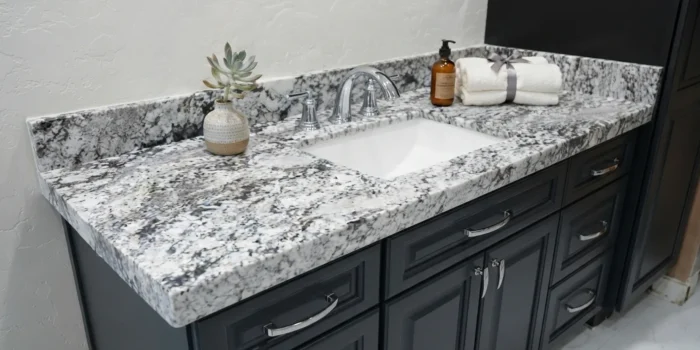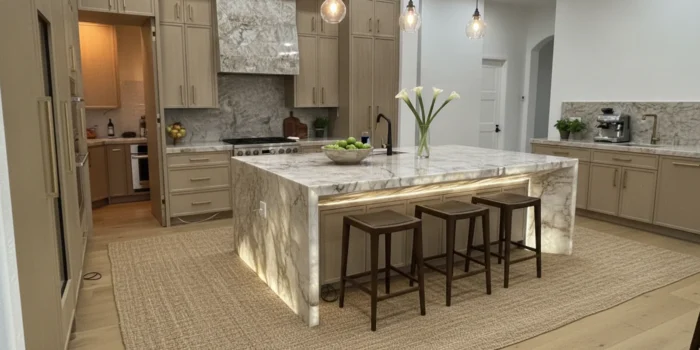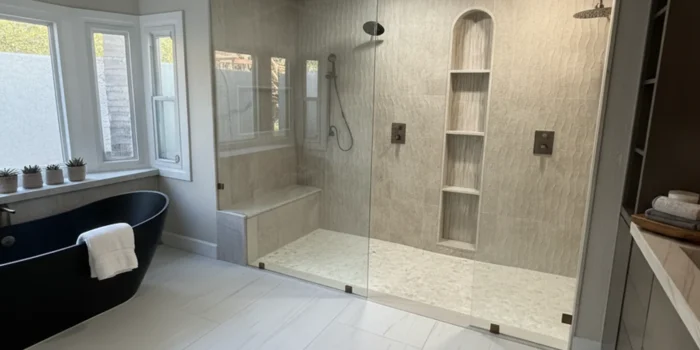
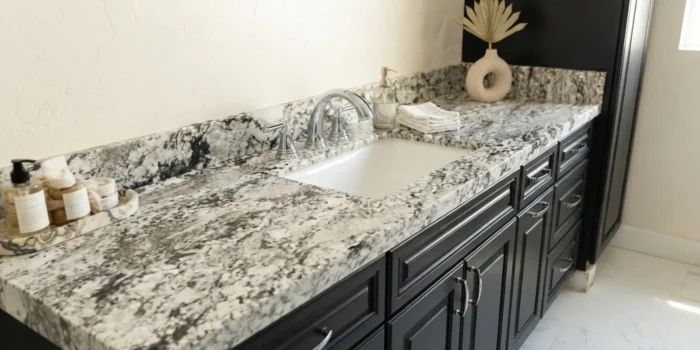
Carrara marble is the white-and-gray Italian stone most people picture when they say “marble countertop,” and it is the most affordable of the classic Italian marbles. In a bright Arizona room it is hard to beat for looks. It is also soft, it reacts to acid, and it records every careless moment in its surface. This guide covers what Carrara is, how it behaves in a Valley home, what it costs, and which look-alikes give you the same feel with less worry.
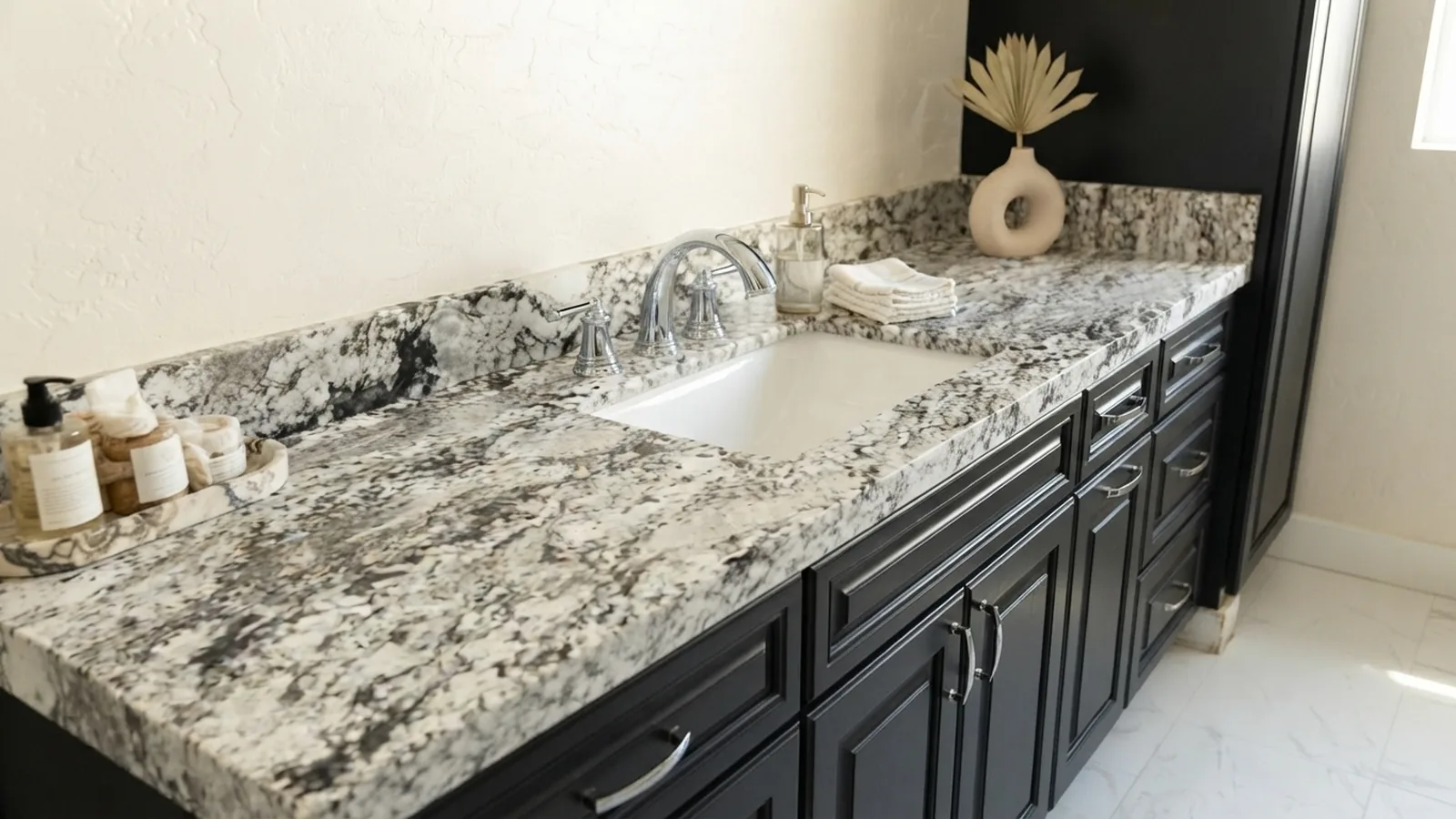
Quick answer: Carrara marble suits a bathroom vanity or a household that welcomes a lived-in patina. It is a weaker choice for a hard-working cooking surface, because it is soft and acids etch it within minutes.
Key takeaways
- Carrara is the entry-level Italian marble, with soft gray veining on a white to blue-gray ground and a price below Calacatta or Statuario.
- Marble reacts with acid, so lemon, vinegar, and wine etch it, even when the stone is sealed.
- A honed finish hides everyday wear far better than a polished one.
- Hard Arizona tap water leaves mineral film, and the usual vinegar-based cleanup damages the stone.
- Quartzite, dolomite, porcelain, and marble-look quartz can give a similar look with less upkeep.
What is Carrara marble?
Carrara marble is a natural white to blue-gray stone quarried near the town of Carrara in Tuscany, Italy, recognizable by its soft, feathery gray veining. Quarrying in the Apuan Alps goes back roughly two thousand years, and Michelangelo’s David came out of the same hills.
It is a metamorphic rock, limestone that heat and pressure recrystallized into interlocking calcite. That explains most of its behavior: it takes a lovely polish, it is soft (about 3 on the Mohs hardness scale, against 6 to 7 for granite), and it reacts with acid.
Carrara is the approachable end of the Italian marble family. Calacatta has a whiter ground and bolder, more dramatic veining, and Statuario pairs the whitest ground with strong gray veins. Both are scarcer and cost more.
“Carrara” is also a color name used on plenty of engineered quartz and porcelain, so when the word appears on a sample, ask whether it is the stone itself or a pattern named after it.
How does Carrara marble hold up in a Phoenix home?
Carrara holds up structurally but not cosmetically: it will not crack or fade under normal use, yet it etches, stains, and scratches more readily than granite, quartz, or porcelain.
Etching is what surprises most people. Lemon juice, vinegar, wine, tomato sauce, and many bathroom cleaners are acidic enough to burn a dull patch into polished marble. Staining is a different problem: oil, coffee, and dye soak into the pores and darken the stone. Sealer slows staining but cannot prevent etching, which is a chemical change to the surface itself.
Valley tap water is hard, meaning dissolved calcium and magnesium that dry into a white film around faucets (the USGS explains water hardness in plain terms). The trap is the cleanup, because the vinegar-based descaler most people grab is exactly what etches marble. A vanity top beside a faucet can turn into a recurring chore.
Heat is less of a worry than people fear. Marble tolerates a hot pan better than laminate or most resin surfaces, though a trivet is still smart. Outdoor kitchens and pool decks are a harder test, with sprinkler water, sunscreen, and big temperature swings, so a harder stone is the safer call out there.
Think of Carrara as a living surface. Owners who love it usually accept that it will develop a soft, worn character over the years, the way old leather does. Owners who expect a showroom finish at year ten tend to regret it.
How does AZ Granite & Remodeling handle a Carrara project?
AZ Granite & Remodeling treats it as a design-build job, meaning one team designs the project, fabricates the stone in its own shop, and installs it. The company has served the Phoenix Valley for more than 20 years, is 5.0-star rated, and works with homeowners in North Scottsdale, Desert Ridge, Peoria, Sun City, and Anthem, plus the wider East and West Valley. The shop is at 1923 W. Cheryl Dr, Suite 2, Phoenix, AZ 85021, but the process starts at your house.
In-house fabrication matters more with marble than with a forgiving stone. A soft, veined material rewards decisions made by the people who will actually cut it: where a seam lands, which way the veining runs across an island, how an edge is profiled, whether a vanity top can come from a single piece. With fewer handoffs between designer, fabricator, and installer, those calls stay with one team instead of getting lost between three.
Marble is one of the materials the team works in, next to granite, quartz, quartzite, dolomite, porcelain, onyx, and natural quartz. That range helps when you are still deciding, because a company that works in only one material has little reason to point you elsewhere. You work one-on-one with a designer, so bring photos of the look you love and expect a straight answer if a different stone fits your life better. You can read more about the marble surfaces AZ Granite works with before you call.
The estimate is free and no-pressure, and it is the right place to ask the questions in the rest of this guide: which finish, how many seams, how the edge would be profiled, and what care the stone will need. Request a free in-home estimate when you are ready, or keep reading if you are still weighing materials.
How does Carrara compare with Calacatta, quartzite, and marble-look quartz?
Carrara is the least expensive and softest of the natural white stones, and quartzite, dolomite, or porcelain will usually outlast it with less fuss. The table compares the usual contenders.
| Surface | Look | Etch and stain behavior | Upkeep | Relative price |
|---|---|---|---|---|
| Carrara marble | White to blue-gray, soft feathery veins | Etches readily, stains if unsealed | Sealing, gentle cleaners, occasional re-honing | Lowest of the natural marbles |
| Calacatta or Statuario marble | Whiter ground, bold dramatic veins | Same as Carrara | Same as Carrara | Highest of this group |
| Marble-look quartz | Uniform, repeating pattern | Resists etching and staining | Wipe clean | Mid |
| Natural quartzite | Natural veining, often white or gray | Usually resists etching, varies by stone | Sealing recommended | Mid to high |
| Dolomite | Marble-like movement, often softer contrast | More resistant than calcite marble, not etch-proof | Light sealing | Mid to high |
| Large-format porcelain | Printed or through-body marble pattern | Does not etch or stain | Wipe clean | Mid to high |
Two caveats. First, quartzite varies by stone: a few slabs sold under that name are softer and more etch-prone than the label suggests, so ask to test your actual sample with a drop of lemon juice before you commit. Natural quartzite is the closest match to marble’s look with a harder body. Second, the price column is a rough ordering, and individual slabs reshuffle it.
Marble-look quartz and printed porcelain give up some character. Their veining repeats from slab to slab, which some people read as less authentic, but many households gladly accept that for a counter that shrugs off a lemon wedge. Dolomite is the quiet option worth asking about: a marble-like stone that is generally harder and slower to react than calcite marble.
What does Carrara marble cost?
Carrara is usually the least expensive marble, commonly quoted around $60 to $120 per square foot installed as a general planning ballpark, with Calacatta and Statuario running higher. That is a market range, not a quote from AZ Granite, and your own number depends on these factors:
- Slab selection. Whiter, more even slabs cost more even within Carrara, and thickness (2 cm versus 3 cm) changes the bill.
- Edge profile. Simple eased edges cost less than ornate profiles, which also leave soft marble more prone to chipping at thin points.
- Seams and cutouts. Every sink, cooktop, and seam adds fabrication time.
- Vein matching. Lining up a pattern across seams uses more slab and more labor.
- Demolition of the old top, plumbing reconnects, and a backsplash all add to the total.
Ongoing costs count too: sealing, and an occasional professional re-hone if etching bothers you. Ask for a price on marble-look quartz or porcelain for the same layout and put the two numbers side by side, since that comparison settles many decisions faster than debate does.
Should you choose a honed or polished finish?
Honed is the safer finish for most households, because a matte surface starts out dull and hides the etch marks that glare on polished stone. Polished marble looks glossy, deepens the color, and resists stains slightly better, but every etch shows as a cloudy spot against the shine.
Honed has a softer, more European look and ages gracefully, though it shows oil marks more readily and leans harder on sealing. Some fabricators also offer brushed or leathered finishes on marble, so ask what is available for the slab you like.
What should you check on the slab before you buy?
Look at the actual slab in natural light before you commit, because Carrara varies more from slab to slab than any catalog photo suggests. The guide to buying marble slabs in Arizona walks through the full inspection. The short list:
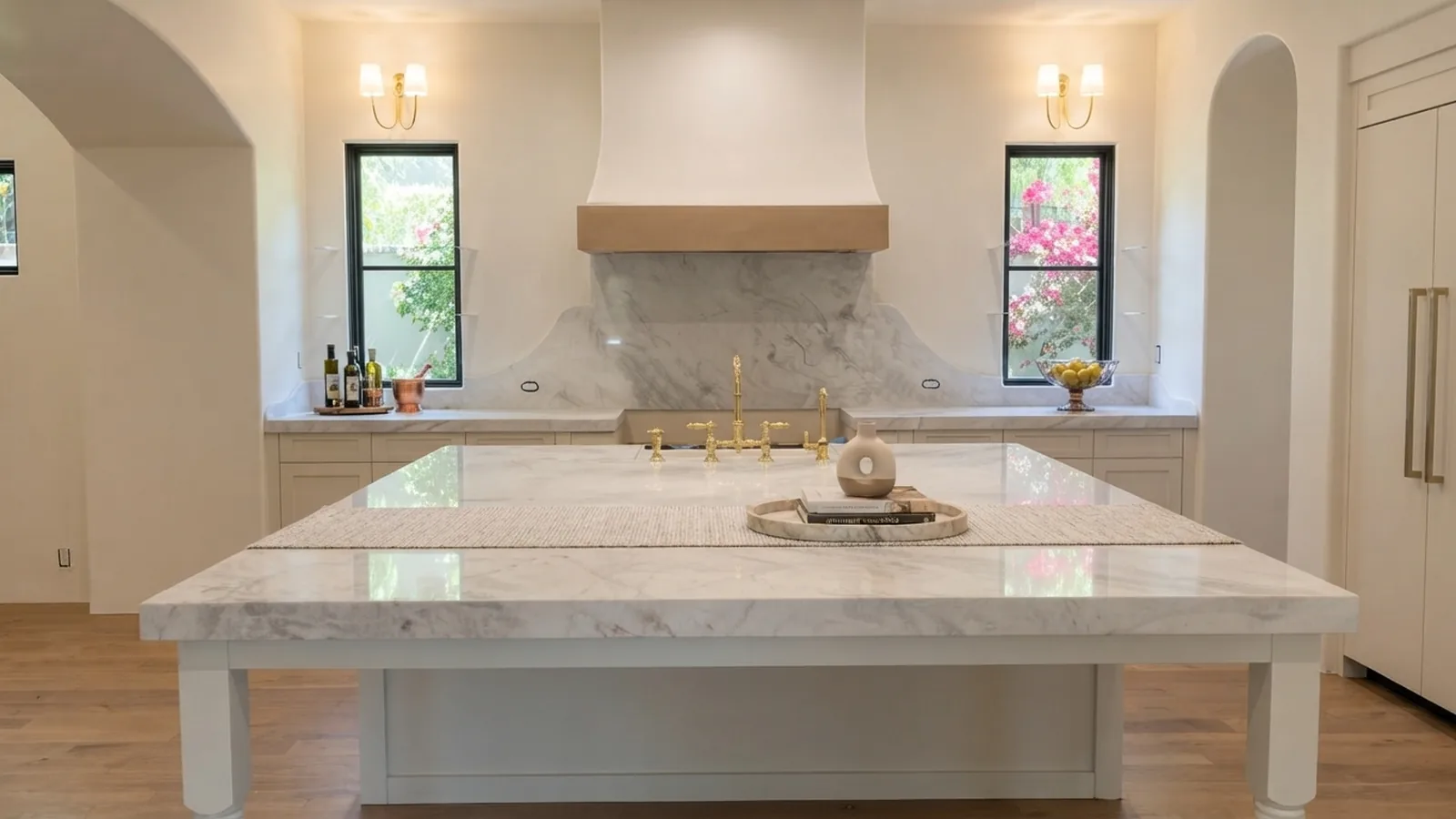
- Hairline fissures. Natural cracks and filled veins are common in marble, and they become weak points near sink cutouts and narrow sections.
- Color. The ground can run from bright white to a cool blue-gray, and it reads differently under indoor lighting than in daylight.
- Vein direction. Decide whether you want the veining to run one way across the whole top, and check where the seams would fall.
- Take a sample home. Leave it by the sink for a week, add coffee, oil, and a lemon wedge, and see whether you can live with the result.
How do you care for Carrara marble day to day?
Daily care is simple: wipe spills quickly, use a pH-neutral stone cleaner, and keep acids and abrasive powders off the surface.
Have the top sealed at installation and resealed when water stops beading. A simple check is to put a few drops of water on the stone; if it darkens within several minutes, the sealer is spent. Ask your fabricator which sealer and schedule fit your finish and habits, and see the Marble Institute of America for general natural-stone care guidance.
Coasters under glasses, a tray under oils and bottles, a cutting board, and trivets cover most of the habits that cause damage. If the stone does etch, a stone restoration professional can re-hone it, and that counts as normal maintenance.
Frequently asked questions
Is Carrara marble the same as white marble?
No. Carrara is one specific marble from Tuscany, while “white marble” also covers Thassos from Greece, Danby from Vermont, and many others. Each has its own veining pattern, tone, and price, so ask for the exact name of the stone on your quote.
Is Carrara marble good for a bathroom vanity?
Yes, a vanity is usually a better home for Carrara than a kitchen counter, since it sees far less food acid. Toothpaste, hair color, nail polish remover, and some face products can still mark it, so treat the top as a place for a tray rather than a shelf for open bottles.
Can you use Carrara marble in a shower or on a floor?
Yes, it is commonly used for both, with two cautions. Polished marble floors get slippery when wet, so honed is the safer pick underfoot, and shower surfaces need sealing and a non-acidic cleaner because soap scum and mineral film build up quickly.
How do you tell real Carrara from marble-look quartz or porcelain?
Ask for the stone’s name and origin in writing, then study the pattern. Natural Carrara veins wander and never repeat, and a cut edge shows the same crystalline grain as the face. Engineered slabs tend to repeat patterns, and printed porcelain may show a plain core at a cut edge.
Does Carrara marble raise resale value?
Not reliably. Some buyers love real marble, while others see a maintenance project, so there is no dependable premium over a more durable surface. If a sale is on the horizon, choose for the buyers you expect rather than for the stone’s reputation.
Can etched Carrara marble be repaired?
Usually yes, by a stone restoration professional who re-hones or re-polishes the surface. Light etching is the easy case, while deep damage or large areas cost more. Ask what that service runs before you buy, since it is the realistic long-term price of choosing marble.
What thickness should a Carrara countertop be?
Most countertops are cut from 2 cm or 3 cm slabs, and the thicker 3 cm is the more forgiving option for a soft stone around cutouts and edges. Your fabricator will advise on support and edge detail for your layout.
Ready to see how Carrara fits your home?
Carrara marble rewards the right household and frustrates the wrong one, so the best first step is an honest look at how you cook, clean, and live. AZ Granite & Remodeling offers a free, no-pressure in-home estimate for homeowners across the Valley and the rest of Arizona. Call (602) 759-9000 or request an estimate online, and bring photos of the look you love. If quartzite or porcelain turns out to be the smarter match, you will hear that too.