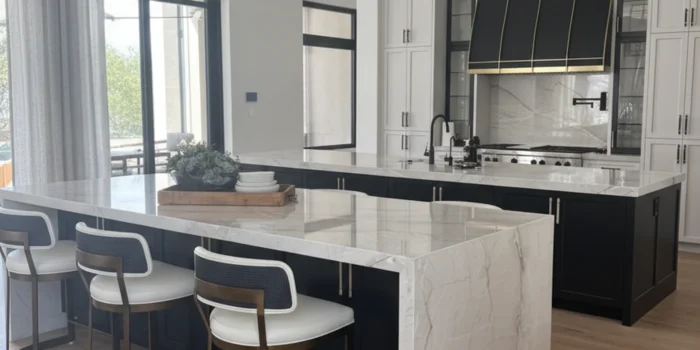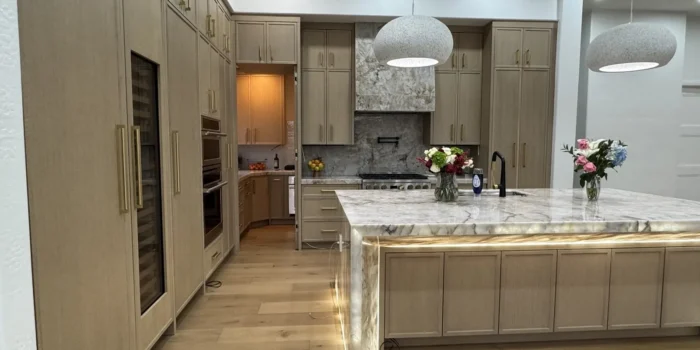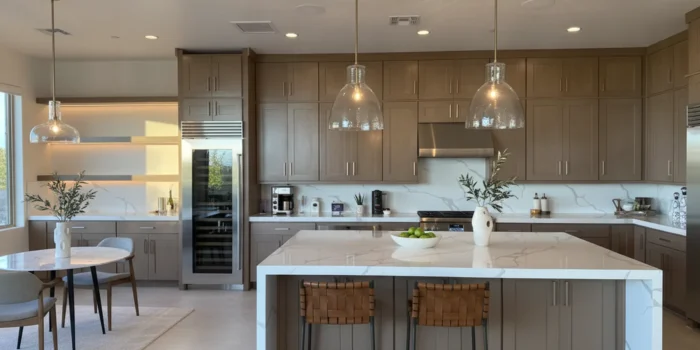
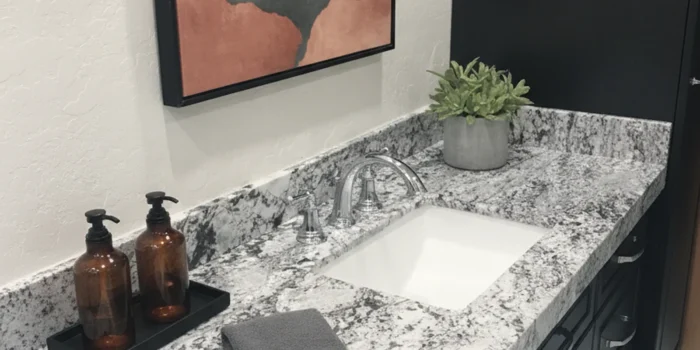
A freshly finished modern kitchen has a way of making the rest of the house look dated, and the bathroom is usually the first room to show it. If you’re researching bathroom remodeling in Phoenix so it lines up with a kitchen you’ve already redone (or are about to), the useful question is which pieces of the kitchen should travel into the bathroom and which shouldn’t. Copying everything rarely works.
This guide sorts that out: the three ways to match two rooms, which stone and tile hold up in a wet room, what Arizona hard water does to fixtures, and how to sequence the work so a color isn’t discontinued before you order it. It also shows how AZ Granite & Remodeling handles a kitchen-and-bath pairing, as one example among several ways to do it.
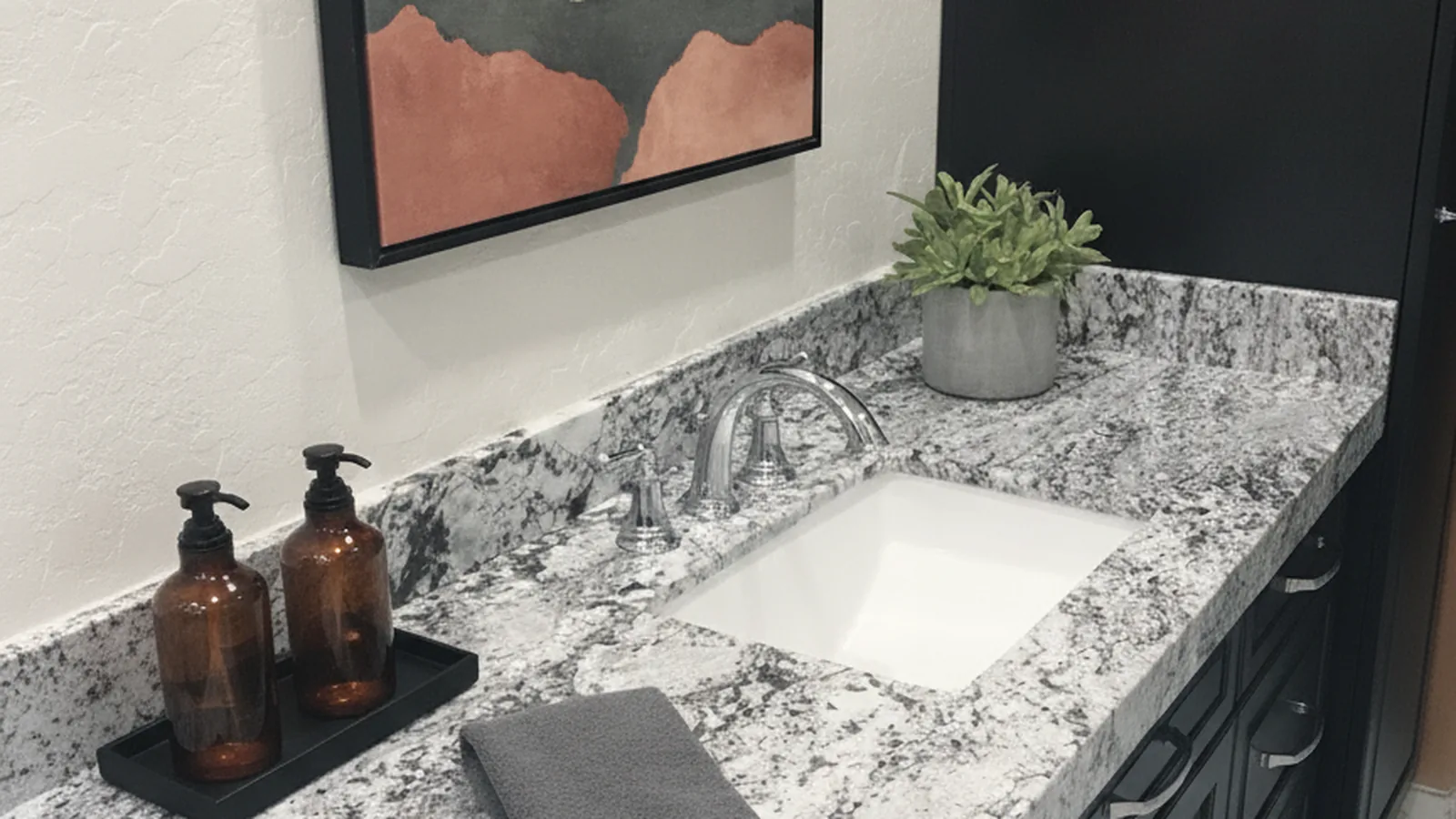
Quick answer: Carry over the stone, cabinet style, and metal finishes from your modern kitchen, then change what a wet room demands: slip-rated floors, moisture-ready cabinets, and fixtures that tolerate hard water. A coordinated bathroom looks planned, while an exact copy of the kitchen tends to look repetitive.
Key takeaways
- Choose a match style first (exact, coordinated, or contrasting), since the stone, tile, and metal decisions all follow from it.
- Natural stone varies from slab to slab and quartz colors get retired, so order for both rooms together when you can.
- In the Valley, hard water is the finish test: brushed and satin surfaces forgive spotting better than polished chrome or matte black.
- Wet-room needs like waterproofing, ventilation, and slip resistance outrank the kitchen’s look every time.
What Is a Matched Bathroom and Kitchen Design?
A matched bathroom and kitchen design means repeating a few deliberate choices in both rooms so they read as one house, without duplicating the kitchen piece for piece.
A modern kitchen usually arrives with a recognizable kit: flat-panel cabinets, slab surfaces in quartz, granite, or porcelain, little or no visible hardware, a restrained palette, and one or two metal finishes. Matching means choosing which of those travel. Three layers do most of the work: surfaces (stone, tile, floor), the vanity and its hardware, and light and color.
The rules that don’t travel matter just as much. A kitchen worries about heat, knives, and acidic spills. A bathroom contends with standing water and humidity, daily toiletries, and bare feet. That’s why a bathroom pulled straight from the kitchen’s spec sheet often looks right and performs badly.
Exact, Coordinated, or Contrasting: Which Kind of Match Fits?
Most homes do best with a coordinated match, where both rooms share a palette and two or three materials without mirroring each other. The table compares the three approaches.
| Approach | What it looks like | Best when | Watch for |
|---|---|---|---|
| Exact match | Same stone, cabinet finish, and hardware in both rooms | A hall bath you see from the kitchen, or a smaller home where the rooms sit close together | Can feel repetitive in a large primary bath, and a retired color can’t be reordered later |
| Coordinated | Shared palette plus one or two shared materials (often the stone or the metal), with different patterns elsewhere | Most single-story and ranch-style homes across the Valley | Needs a written plan so “similar” doesn’t drift into “almost” |
| Contrasting | A bolder bathroom (veined stone, darker tile, a statement mirror) with one tie-in to the kitchen | Powder rooms and guest baths behind a closed door | Without a shared metal or color, it can look like a different house |
Where the bathroom sits matters as much as the style you pick. A hall bath you pass on the way to the kitchen gets seen in the same glance, so it should lean exact or coordinated. A primary bath behind a bedroom door can carry more personality. A powder room is the cheapest place to try something contrasting, because the surface area is tiny.
How AZ Granite & Remodeling Handles a Kitchen and Bath Match
AZ Granite & Remodeling is one concrete example of how a design-build shop approaches this. It is a remodeling contractor and in-house stone fabricator that has served the Phoenix Valley for over 20 years, working with homeowners in North Scottsdale, Desert Ridge, Peoria, Sun City, Anthem, and the surrounding East and West Valley. Its customers rate it 5.0 stars.
For a matching project, the useful question is who touches the stone. AZ Granite does custom fabrication and installation in its own Phoenix shop, so the kitchen counters and the vanity top can be specified together: the same edge profile, the same finish (polished or honed), and seams placed with the same logic. When fabrication is split across vendors, those small details are where two rooms drift apart.
The process starts with a one-on-one conversation with a designer, which is the design-build “form and function” idea in practice. Layout, surfaces, and installation are planned as one job. The material list covers granite, marble, quartz, quartzite, dolomite, porcelain, onyx, and natural quartz, so a quartz kitchen and a quartzite primary bath can come out of a single conversation. Services span kitchen remodeling, the bathroom remodeling service, countertops, and flooring.
The kitchen doesn’t have to be theirs. Bring a cabinet door, a stone sample, and a hardware piece to the in-home estimate, and a designer can work from physical samples. You can also view granite remnants, which are offcuts from full-slab jobs fabricated in house, by appointment at the Phoenix shop, and they are worth a look for a small vanity. Estimates are free, in-home, and no-pressure, so you can request one here and compare the plan against anything else you’re collecting.
Which Stone and Tile Carry Into a Bathroom?
Quartz, granite, quartzite, and porcelain carry from a modern kitchen into a bathroom with almost no changes. Marble, dolomite, and onyx work too, but they ask more of you.
- Quartz is the easiest to match across rooms because the pattern is manufactured, so two slabs from the same line look alike. The bathroom catch is heat: the resin binder dislikes direct high heat, and a hot styling tool left on the vanity is the bathroom’s version of a hot pan. This quartz vs granite comparison covers the Arizona trade-offs in depth.
- Granite tolerates heat and is a safe pick near hot tools, but the pattern varies from slab to slab. Matching means selecting from the same slab or lot, never from a photo, and it needs periodic sealing.
- Quartzite and dolomite give the soft, veined look of marble with more resilience. Each slab is its own, so view it in person.
- Marble is gentler on a vanity than it would be on a kitchen counter, since the bathroom sees fewer acidic spills. Toothpaste, some cleaners, and hard-water scale can still dull a polished surface, and a honed finish hides that better.
- Onyx is translucent and can be backlit, which is dramatic and fragile. It suits a vertical accent or a low-traffic vanity better than a daily-use top.
- Porcelain slabs and large-format tile suit shower walls and floors, because fewer grout lines mean less scrubbing. If the kitchen has a porcelain counter or backsplash, carrying it into the shower is the cleanest match available.
Cabinets, Hardware, and Fixtures: Where Hard Water Changes the Plan
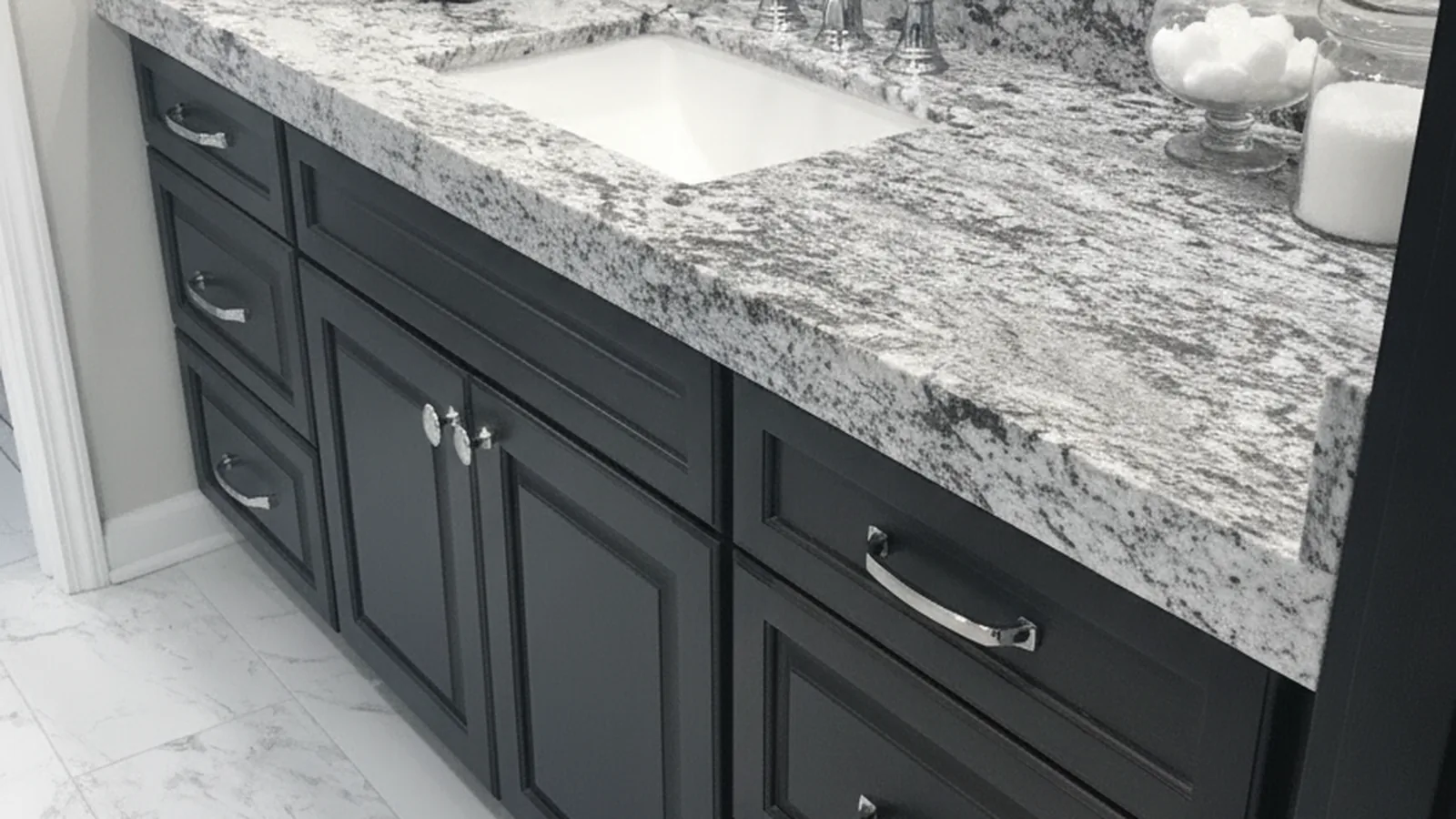
Limit the bathroom to two metal finishes, and choose them for how they handle hard water as much as for how they look in the showroom.
Much of the Valley has hard water, meaning water that carries dissolved calcium and magnesium, as the USGS explains. Those minerals leave the white crust on faucets and glass. Polished chrome and matte black show spotting fastest. Brushed nickel, brushed brass, and satin finishes forgive it, and a quick wipe after use keeps any finish presentable. If the kitchen has black fixtures you love, repeat the color in a mirror frame or cabinet pulls, where water rarely lands, and choose a brushed finish for the faucet.
The kitchen’s flat-panel door style travels well to the vanity, but ask what the cabinet box and finish are rated for in a humid room. A door that swells at the bottom edge costs more to fix than the difference between a basic and a better box. Plain slab doors also wipe down more easily than recessed-panel styles.
On faucets, the EPA’s WaterSense program labels bathroom faucets that flow at 1.5 gallons per minute or less. Plenty of modern styles carry the label, so check for it before you buy and you won’t trade the look for water savings.
Light, Color, and the Small Tie-Ins That Do the Most Work
Use the same color temperature in both rooms, or identical stone will look warm in one and gray in the other. Warm white bulbs in the 2700K to 3000K range are the usual choice for homes. Pick one and stay with it.
Arizona daylight is strong and white, which makes many stones read cooler by midday. Test samples in the actual room in the morning and again in the afternoon before you commit.
Then add small tie-ins that cost little: a mirror frame that echoes the kitchen’s pendant finish, the same grout color, the same paint in a different sheen. If the kitchen has one accent color, repeat it once in the bathroom, in something removable like towels or art, so the fixed materials stay neutral.
What Matching Costs and How to Sequence the Work
Matching costs less than most people fear because a bathroom uses far less stone than a kitchen. A vanity top is often roughly 5 to 12 square feet, against 30 to 60 or more in a kitchen.
What moves a bathroom budget is whether plumbing relocates, how the shower is built (tile, slab walls, or glass), the stone grade and slab count, the edge profile, and the fixture tier. This Phoenix bathroom cost breakdown lays out ranges by scope, and a free in-home estimate turns those ranges into a number for your house.
A sensible order of work looks like this:
- Save the kitchen’s specs now: the stone name and where it was fabricated, the cabinet finish name, and hardware and fixture part numbers.
- Choose stone and tile for both rooms in one sitting, since lots vary and colors get retired.
- Ask for an estimate that covers both rooms, even if the bathroom follows months later.
- Confirm permits before demolition. Work that moves plumbing or electrical can require one in Phoenix, and your contractor should tell you who handles it.
Mistakes That Make Two Rooms Look Mismatched
- Choosing stone from a photo or phone screen. Sheen, veining, and undertone only read true in the real room under Arizona daylight.
- Using three or four metal finishes because each looked good on its own.
- Carrying a kitchen backsplash pattern into a shower without planning for grout lines and glass.
- Skipping the ventilation plan. A tight, modern bathroom still needs a properly ducted fan, even in a dry climate.
Frequently Asked Questions
Can I use leftover kitchen stone for a bathroom vanity?
Often, yes, if a large enough piece remains. A vanity top needs one clean piece, usually about two feet deep, so ask your fabricator whether any offcuts from your kitchen job fit. Leftovers from your own slab match better than new stone ordered later, because natural stone varies from slab to slab.
Can I match a kitchen that another company installed?
Yes, by working from physical samples rather than product names. Bring a cabinet door, a piece of the stone, and a hardware sample to the estimate. Natural stone and some finishes will never be identical, so aim for a close coordinate and avoid placing the two rooms where they are compared side by side.
How do I get a modern kitchen look into a small bathroom?
Use fewer, larger surfaces. One slab or large-format tile on the main wall, a floating or slab-front vanity that shows floor, and a frameless glass panel keep the lines quiet and the room open. Skip the kitchen’s busy backsplash pattern, because in a small room light colors and fewer grout lines do more work than any detail.
Should the bathroom floor match the kitchen floor?
Usually not the exact product. A kitchen floor often runs as plank or large tile for flow, while a bathroom floor needs a wet slip rating (ask for the tile’s DCOF value) and a plan for water at the shower threshold. Match the tone and tile size instead, and the two rooms will still look related.
Does matching the two rooms help resale?
It can help the home photograph and show well, but no remodel guarantees a return. Buyers weigh condition and function first, and a matched bathroom that leaks or looks cheap won’t help. If resale is a driver, ask your contractor which finishes buyers in your neighborhood expect.
Is porcelain or quartz better for a shower wall?
Both are used, and the better choice depends on seams and the manufacturer’s guidance for wet installs. Large-format porcelain slabs are common in showers because the material is dense and needs few joints. Quartz suits a vanity wall beautifully, but confirm its wet-area guidance with your fabricator before committing.
What should I bring to an in-home estimate?
Bring anything that shows the kitchen’s look: a cabinet door, a stone sample or the stone’s name, a hardware piece, and photos of rooms you like. Add measurements if you have them and a list of what bothers you about the current bathroom. The designer can then build the plan around real samples instead of guesses.
Planning a Bathroom That Belongs With Your Kitchen
A bathroom that picks up three or four cues from a modern kitchen looks intentional, and it lasts longer in Arizona when the finishes are chosen for hard water and heat. Decide the match style, buy the stone and tile for both rooms together, and keep the wet-room rules ahead of the look.
If you’d like a second set of eyes on your plan, AZ Granite and Remodeling offers a free, no-pressure in-home estimate across the Valley. Call (602) 759-9000, email veny@azgranite.us, or use the contact page. The shop is at 1923 W. Cheryl Dr, Suite 2, Phoenix, AZ 85021, and it has served homeowners in Phoenix, Arizona for more than 20 years.