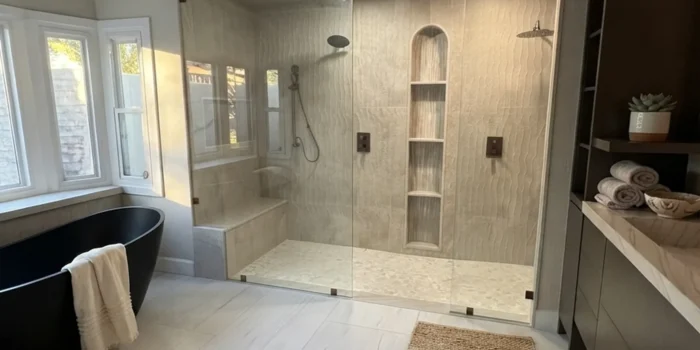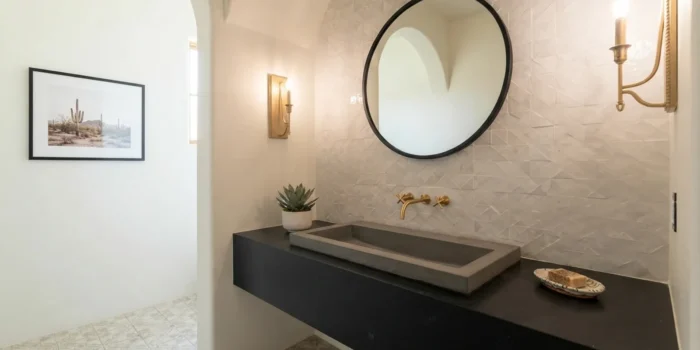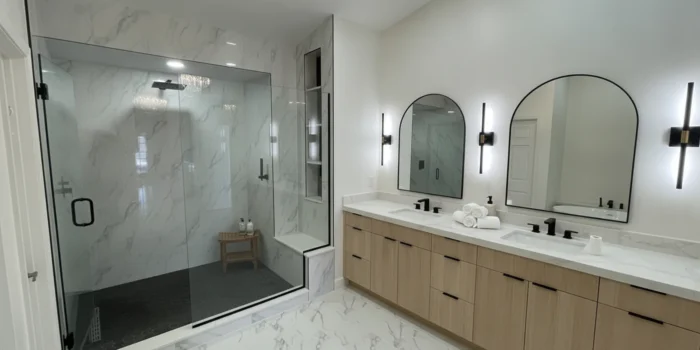
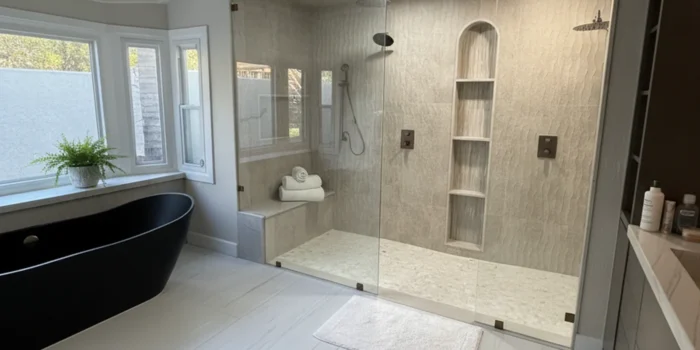
If you’re planning bathroom remodeling in Phoenix, hard water deserves a say before you fall for any tile or fixture. Much of the Valley’s tap water carries a heavy load of dissolved minerals, and the desert’s dry air makes every droplet evaporate fast, leaving those minerals behind as white crust on glass, chrome, and stone. A shower that looks flawless on install day can look tired within a year if the materials fight the water. This guide covers what hard water damages, which surfaces cope best, when treating the water makes sense, and where AZ Granite & Remodeling fits.
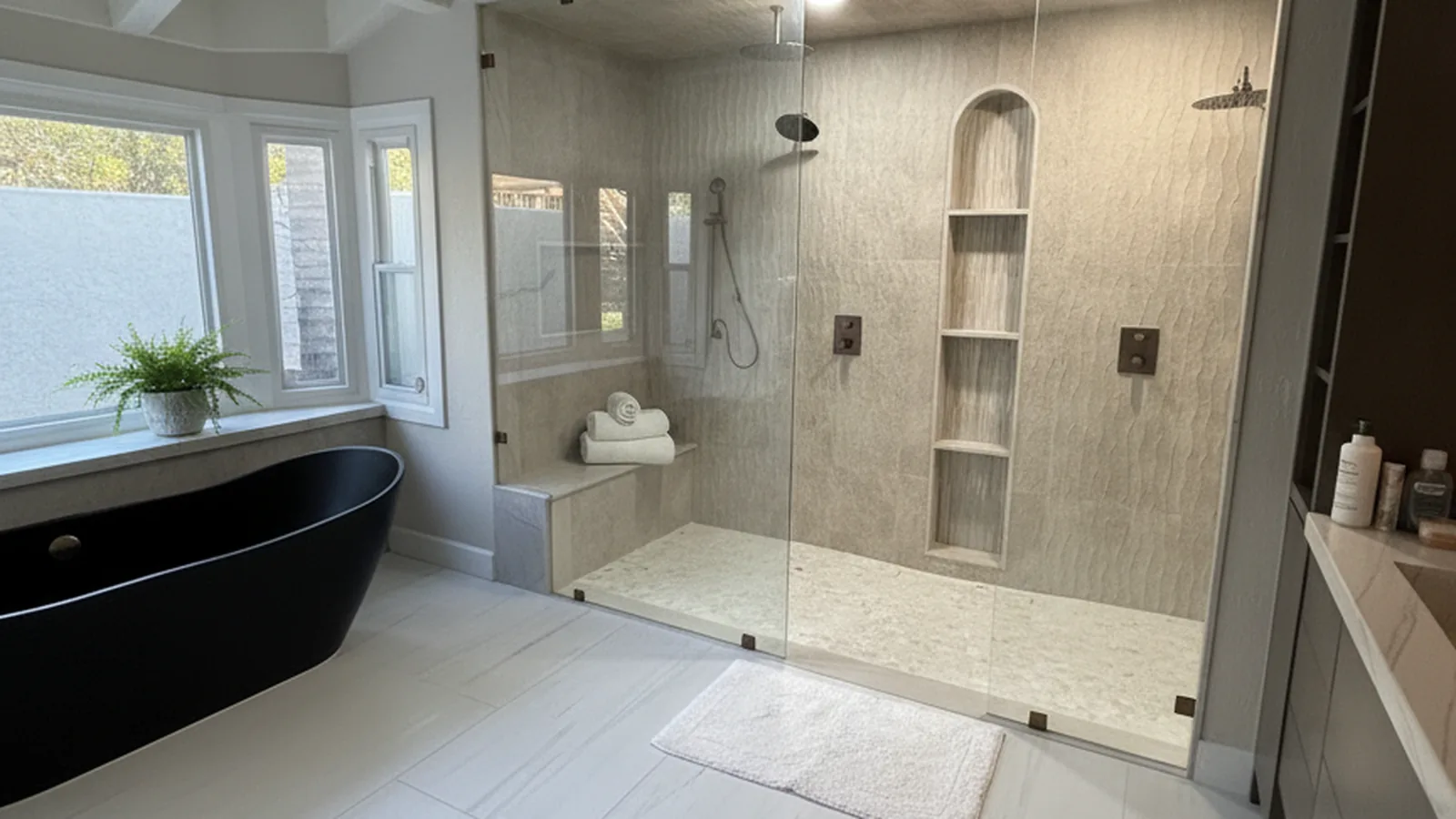
Quick answer: Choose non-porous surfaces like porcelain, quartz, or well-sealed granite and quartzite, keep acid-sensitive stone out of the shower, and pick forgiving fixture finishes. Mineral spotting in Phoenix can’t be stopped, but the right choices make it a quick wipe instead of a weekend scrub.
Key takeaways
- Hard water damage is cosmetic at first, then mechanical, and you can fully prevent the cosmetic stage.
- The usual scale remedy, vinegar or citric cleaner, etches marble, onyx, and travertine, so the cleaner can hurt more than the water.
- Etched glass is permanent once it starts, which makes prevention far cheaper than repair.
- Most hard-water complaints begin at the grout.
- Settle the water-treatment question before you finalize fixtures, because it changes which ones are worth buying.
What is hard water, and why does Phoenix have so much of it?
Hard water is tap water carrying a high level of dissolved calcium and magnesium. The U.S. Geological Survey’s hardness scale calls water soft up to 60 milligrams per liter, moderately hard to 120, hard to 180, and very hard above 180. Valley water travels through desert rivers, canals, and groundwater that pick up minerals along the way, so hard to very hard is the norm here. The exact number shifts by neighborhood because different utilities draw from different sources.
The bathroom problem is evaporation. When water dries, the minerals stay. In Arizona’s low humidity a droplet on a shower wall is gone in minutes, so spots set before most people reach for a towel. Heat makes it worse, because calcium carbonate drops out of water more readily as it warms. That’s why showerheads, tub spouts, and water heaters collect scale first.
How does hard water show up over the years?
Hard water damages a bathroom in stages, and only the first stage is purely cosmetic.
Early on you get white spotting on glass and chrome, a dull film on tile, and soap that never quite rinses clean. All of it is reversible. In the middle years the damage turns physical: etched glass, discolored grout, showerheads spraying sideways, aerators that sputter, and valve cartridges that stick. Some of that is repairable and some is not. Over the long term, sediment builds in the water heater, efficiency drops, and old shutoff valves stop sealing cleanly. The rest of this guide is about staying in that first stage for as long as possible.
How does AZ Granite & Remodeling handle a bathroom built for hard water?
AZ Granite & Remodeling treats hard water as a design decision made up front, by one team that also fabricates the stone. The company is a design-build remodeling contractor and in-house stone fabricator at 1923 W. Cheryl Dr, Suite 2, Phoenix, AZ 85021, with more than 20 years serving Arizona homeowners and a 5.0-star rating.
One designer, one shop. You work one-on-one with a designer, and custom fabrication and installation happen in house. In a wet room that matters because the decisions interact: which surface goes on the vanity, how the stone is finished, where seams land, and how sink cutouts are handled. One team makes those calls together, balancing form and function, instead of passing them among a stone yard, a fabricator, and an installer.
Honest material trade-offs. The shop works in granite, marble, quartz, quartzite, dolomite, porcelain, onyx, and natural quartz. Some of those are forgiving in a shower and some are demanding, so a design conversation is most useful when it tells you which is which for your bathroom instead of leaving you to choose by looks alone.
A free estimate at home. In-home estimates are free and no-pressure, and the visit is the right moment to raise your water. Mention whether you already have a softener, point out the spotting on your current glass and fixtures, and ask how each material would hold up. A whole-house softener is plumbing and water-treatment work rather than tile or stone work, so ask any contractor, including this one, how it would be coordinated and quoted.
For a full project, start with the bathroom remodeling page. The crew works across the Valley, including North Scottsdale, Desert Ridge, Peoria, Sun City, and Anthem, plus the surrounding East and West Valley.
How hard is your water, really?
Start with your utility’s annual water quality report, which most Valley utilities publish and which usually lists hardness or the minerals behind it. The City of Phoenix Water Services Department covers its own customers, and other cities and private utilities publish theirs. Hardness is reported either in milligrams per liter or grains per gallon, and one grain per gallon equals roughly 17 milligrams per liter.
Two caveats apply. A home a few miles away can sit on a different utility and source, so a neighbor’s number may not be yours. And a softener already installed in the garage or utility closet changes the picture completely, so check before you assume the worst. A basic hardness test strip from a hardware store will confirm what comes out of your own tap.
Which bathroom surfaces handle Phoenix hard water best?
Non-porous surfaces handle hard water best: glazed porcelain, quartz, and properly sealed granite or quartzite all keep mineral deposits on top, where a cloth can remove them. Here is how the common choices compare.
| Surface | How Phoenix hard water treats it | Upkeep to expect | Relative cost |
|---|---|---|---|
| Glazed porcelain tile or slab | Mineral film sits on the glaze and wipes off; grout lines are the weak point | Low on the tile, moderate on the grout | Tile is budget-friendly, large slabs run higher |
| Quartz | Non-porous, so spots and film stay on the surface | Low; avoid abrasive scrubbing | Mid-range |
| Sealed granite | Resists scale and acid well; weak sealing lets stains in | Periodic resealing | Mid-range, varies widely by slab |
| True quartzite | Hard and acid-tolerant, but still needs sealing | Periodic resealing | Varies by slab |
| Dolomite | Less reactive than marble, but still a carbonate stone that can dull with acid | Moderate; test a sample first | Varies by slab |
| Marble, onyx, travertine | Etched by acidic cleaners, and scale bonds to the etched spots | High; best kept out of the shower | Wide range, with onyx at the top |
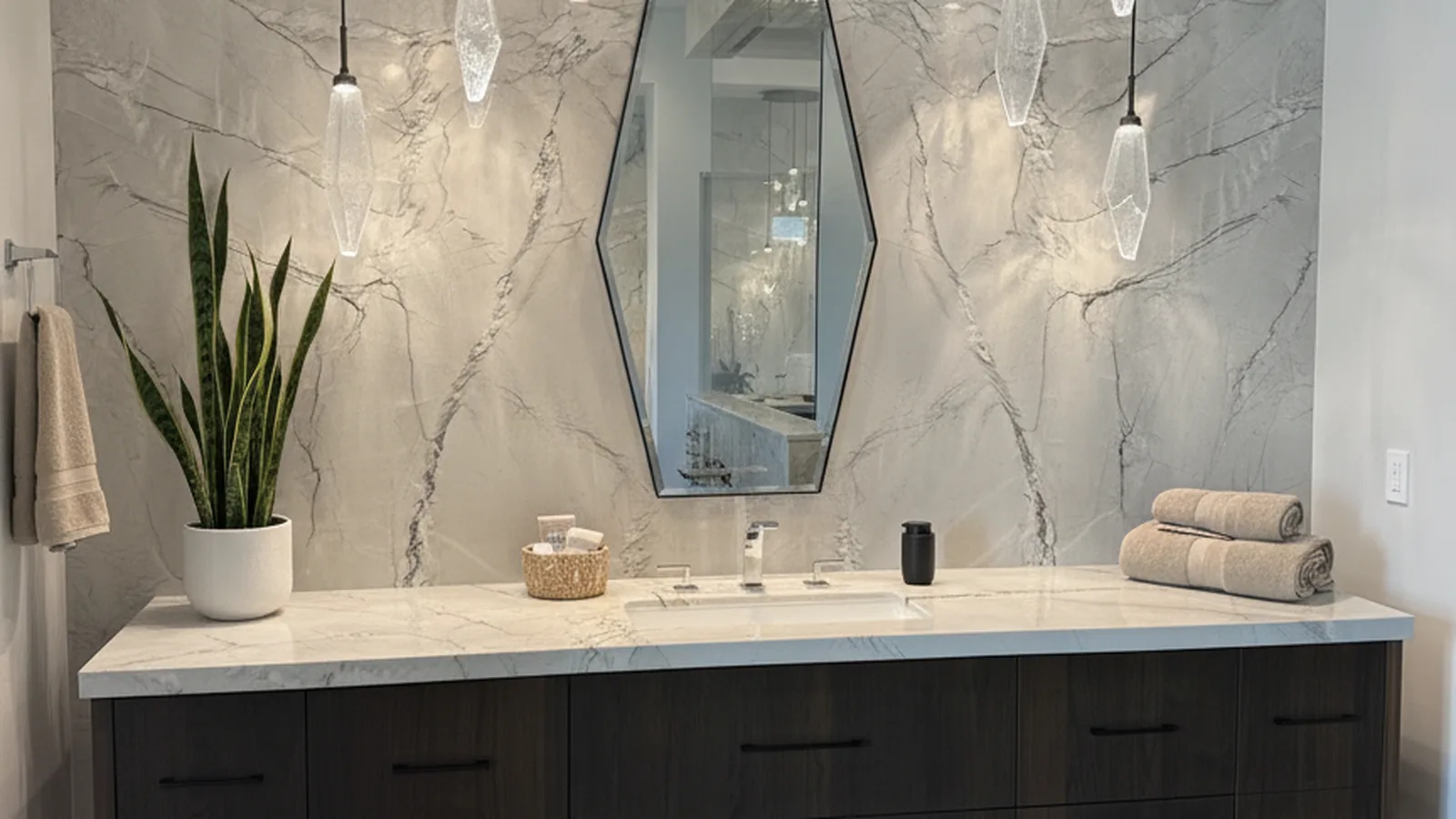
Cleaning is a trap of its own. Vinegar and citric-acid descalers dissolve scale well on glass and chrome, but they etch marble, onyx, and travertine, leaving dull patches that grab more scale next time. If you love marble, put it where it rarely gets splashed and ask the fabricator for a stone-safe cleaner. Quartzite needs a caution too: true quartzite is quartz-based and tolerates acid, but the name gets applied to some softer, carbonate stones, so confirm what you’re buying.
For more on how engineered quartz behaves in Phoenix heat and water, read this guide to quartz countertops for Arizona homes.
Glass, grout, and fixtures: where does hard water win or lose?
Glass, grout, and fixtures are where hard water does its most visible damage, and each has a practical fix.
Shower glass
Frameless glass is the part of a modern shower most sensitive to hard water, because mineral film left on it eventually etches the surface. Ask about a factory-applied protective coating and read what the warranty requires of you. Then build the habit, since a squeegee takes seconds after each shower. A fixed panel with a smaller opening cuts the glass area you have to keep clear, and a working exhaust fan helps everything dry faster.
Grout and tile layout
Standard cement grout is porous, so it is usually the first thing to look dirty. Epoxy or urethane grout resists staining far better, though it costs more and needs an experienced installer because it sets quickly. Larger-format tile means fewer grout lines to maintain, and sealed cement grout remains the budget route if you accept periodic resealing.
Faucets and showerheads
Chrome and brushed nickel hide mineral spotting well. Matte black and some brass-toned finishes show white crust plainly and can be marred by scrubbing, though PVD-coated versions wear better than basic plating. Showerheads with flexible silicone nozzles let you rub deposits off with a thumb, which keeps the spray pattern true.
Should you treat the water or design around it?
Design around it first, then treat the water if scale is already costing you appliances or hours of cleaning. The usual options:
- Salt-based softener. Swaps calcium and magnesium for sodium, which removes the hardness. It needs salt refills, a drain connection, and periodic service, and some communities and HOAs have rules about softener discharge, so check yours.
- Salt-free conditioner. Changes how minerals form scale instead of removing them. Results vary, so set expectations below what a true softener delivers.
- Reverse osmosis at one tap. Improves drinking water at the kitchen sink and does nothing for showers.
Whatever you choose, water heaters benefit from periodic flushing or descaling. Tank units collect sediment and tankless units scale up inside, so ask a plumber about a service schedule. A whole-house softener is a real line item, often in the low-to-mid thousands installed, plus ongoing salt and service.
What drives the cost of a hard-water-ready bathroom?
Surface choice moves the price more than any other hard-water decision. After that, the add-ons are modest next to the project total:
- Surface: porcelain tile sits at the budget-friendly end, while premium slabs of quartz or natural stone cost considerably more.
- Grout: epoxy adds material and labor over standard cement.
- Glass: a protective coating adds a small amount, while door style and thickness add far more.
- Fixtures: PVD finishes and better cartridges cost more up front and can save replacements.
- Water treatment: the largest optional line, covered above.
Together these usually matter less than scope, layout changes, or moving plumbing. For the bigger picture, see this breakdown of bathroom remodeling costs in Phoenix by scope.
What should you ask a contractor before you sign?
Ask five questions and write down the answers:
- Which surfaces in the shower are non-porous, and which need sealing, and how often?
- What protects the glass, and what does the warranty ask me to do?
- Does the bid name the grout product, or just say “grout”?
- Can I take a sample home, wet it, and let it dry?
- How are surprises handled if scale or corrosion turns up behind the wall?
The fourth question costs nothing and tells you more than a sample viewed under store lighting ever will.
Frequently asked questions
Is Phoenix hard water unhealthy?
Generally no. Hardness itself is considered a nuisance rather than a health risk, since calcium and magnesium are harmless minerals. The problems are spotting, scale, and shorter appliance life. Questions about specific contaminants are separate, and your utility’s water quality report is the place to look for those.
Which finishes hide water spots best?
Mid-tone surfaces with natural movement in the pattern hide spots best, especially in a honed or satin finish. Solid black and other dark, high-gloss surfaces show every dried droplet, and the same goes for matte black fixtures. Judge samples in your own bathroom light rather than only under store lighting.
Install a softener before remodeling?
Yes, before or during the project is better than after. New valves and fixtures then never see hard water, and plumbing work is easier to schedule while the project is already underway. A softener installs where water enters the home rather than in the bathroom, so treat it as a plumbing job to coordinate with the remodel schedule.
Do shower filters fix hard water?
Mostly no. Typical shower filters target chlorine and some other contaminants, not the calcium and magnesium behind scale, so spotting and film continue. Some products claim to reduce scale, but results vary. Removing hardness before it reaches the shower takes a whole-house softener.
How often should stone be resealed?
There is no universal schedule, because it depends on the stone, the sealer, and how often the surface stays wet. A simple check is to put a few drops of water on the stone. If they darken it and soak in instead of beading, it is due. Ask your fabricator for a recommendation for your specific slab.
How long do faucets last?
Expect shorter cartridge and aerator life than a manufacturer’s best-case claims. Scale jams moving parts and clogs small openings, so choose fixture lines with easy-to-find replacement cartridges, and ask that the shower valve be reachable through an access panel instead of buried behind finished tile.
Does an older home change things?
Often yes. Older homes may have supply lines or shutoff valves clogged with years of scale, and some have galvanized piping that restricts flow. A remodel opens the walls, so it is the natural time to find out and replace what is tired. Budget a little room for surprises behind the wall.
Ready to plan around your water?
Bathroom remodeling in Phoenix with hard water in mind comes down to three calls: non-porous surfaces where water lands, durable grout and glass, and a clear decision on treating the water. If you’d like a designer’s read on your own bathroom, call AZ Granite & Remodeling at (602) 759-9000, email veny@azgranite.us, or request a free, no-pressure in-home estimate.