If you’ve lived through a Phoenix summer, you already know surfaces here take a beating that countertops in milder states never see. Afternoon sun pours through south-facing windows for months. Outdoor kitchens sit in 110-degree heat. Hard water leaves a chalky film on everything it touches. A countertop that looks perfect in a showroom can behave very differently once it’s living in the desert.
So the honest answer to “what’s the best countertop for Arizona heat” depends heavily on one thing most articles skip: whether the surface lives indoors or outdoors. That single question changes the whole recommendation.
Quick answer: For most Arizona kitchens, natural stone handles our climate best. Granite and quartzite resist both heat and UV, so they hold up near sunny windows and outdoors. Engineered quartz is excellent indoors and easy to maintain, but its resin binder can discolor in constant direct sun, so it’s the weaker pick for patios and outdoor kitchens.
Key takeaways
- Natural stone wins outdoors. Granite, quartzite, and porcelain resist UV fading and high heat, making them the safer choice for Arizona patios and sun-drenched rooms.
- Engineered quartz is best indoors. It’s nonporous and low-maintenance, but direct desert sun can yellow the resin over years, so keep it away from unshaded outdoor use.
- Indoor versus outdoor matters more than the brand or color you pick.
- Hard water and UV, along with heat, are the real Arizona stress tests for any surface.
What is a heat-resistant countertop in Arizona?
A heat-resistant countertop is one that resists three separate desert stresses: direct thermal contact, prolonged UV exposure, and thermal shock. Most homeowners only think about the first one, but in Arizona all three matter.
Thermal contact is the hot pan you set down without a trivet. UV exposure is the slow, invisible damage from months of sunlight, which can fade color or break down the binders in man-made surfaces. Thermal shock is the crack that can happen when one part of a slab gets very hot while the rest stays cool, common on outdoor counters that catch morning sun on one edge only.
Natural stone forms under heat and pressure, so it’s inherently stable against sunlight and high temperatures. Engineered surfaces are made by binding crushed stone with resin, and that resin is where UV and extreme heat cause trouble. Knowing that one difference explains almost every recommendation below.
Why the desert is harder on countertops than most climates
Arizona combines stressors that rarely show up together elsewhere. Our UV index regularly hits “extreme” for much of the year, which accelerates any color change a material is prone to. Summer surface temperatures on a sunlit counter can climb far above the air temperature. And the Valley’s notoriously hard water leaves mineral scale that dulls polished finishes over time.
Add in how we live here. Indoor-outdoor kitchens are common across North Scottsdale, Desert Ridge, Peoria, Anthem, and the newer HOA-era builds around the Valley. Big walls of glass invite the sun deep into the room. All of that means the “best” countertop in Phoenix isn’t always the same as the best countertop in a cooler, cloudier city. According to the Natural Stone Institute, material selection should always account for the specific exposure a surface will face, and few places test that harder than the desert.
Getting honest desert-specific advice: AZ Granite & Remodeling
If you’d rather not guess which material suits your exact room, a local design-build shop that fabricates its own stone is worth a conversation. AZ Granite & Remodeling has served the Phoenix Valley for over 20 years, and it fabricates countertops in its own Phoenix shop rather than outsourcing the cut. That in-house control matters in a climate this demanding, because the crew that recommends a slab is the same one that templates, cuts, and installs it.
What’s genuinely useful for a homeowner sorting through heat and UV questions is that they work through material choice one-on-one with a designer first. Because they handle granite, marble, quartz, quartzite, dolomite, porcelain, onyx, and natural quartz, the recommendation isn’t steered by whatever single product a shop happens to stock. You can walk through the full range on their materials overview, and their free, no-pressure in-home estimate lets someone see your actual light exposure, window orientation, and whether a run of counter sits in afternoon sun.
That last part is the desert-specific piece a generic guide can’t give you. A slab that’s ideal for a shaded galley kitchen may be the wrong call for an island under a skylight. Seeing the room is how you get that right. Everything below stays general, so you can weigh the options yourself before anyone visits.
The real range of options for Arizona homes
Here’s how the common surfaces actually behave in our climate, from most forgiving of sun and heat to least.
Granite is a desert workhorse. It’s a natural igneous stone, so it shrugs off UV and takes real heat without discoloring. You still don’t want to make a habit of parking scorching pans on it, but it tolerates the occasional hot pot far better than man-made surfaces. It needs periodic sealing to fend off stains and hard-water etching. For sunny rooms and outdoor kitchens alike, granite is a reliable choice.
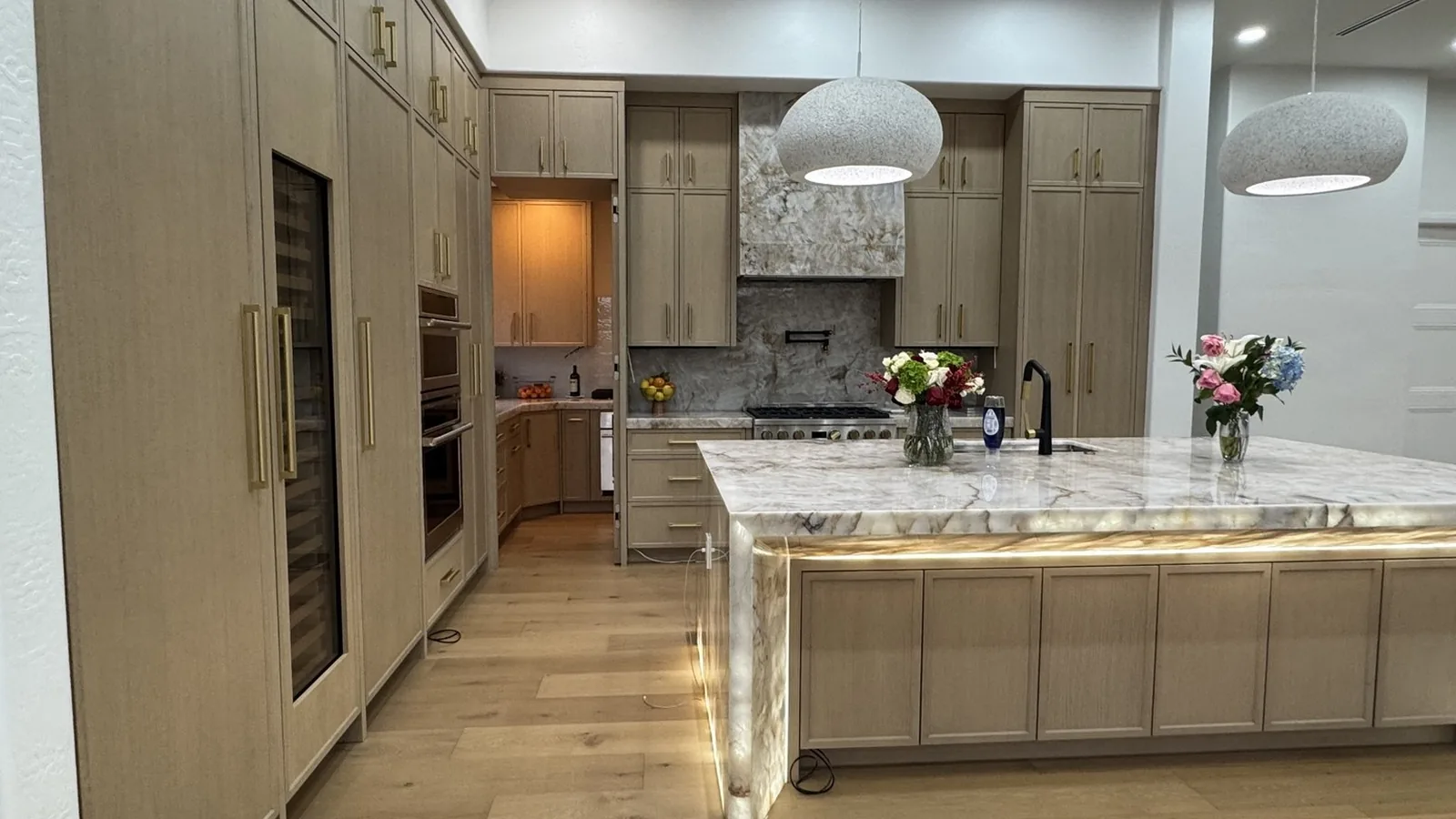
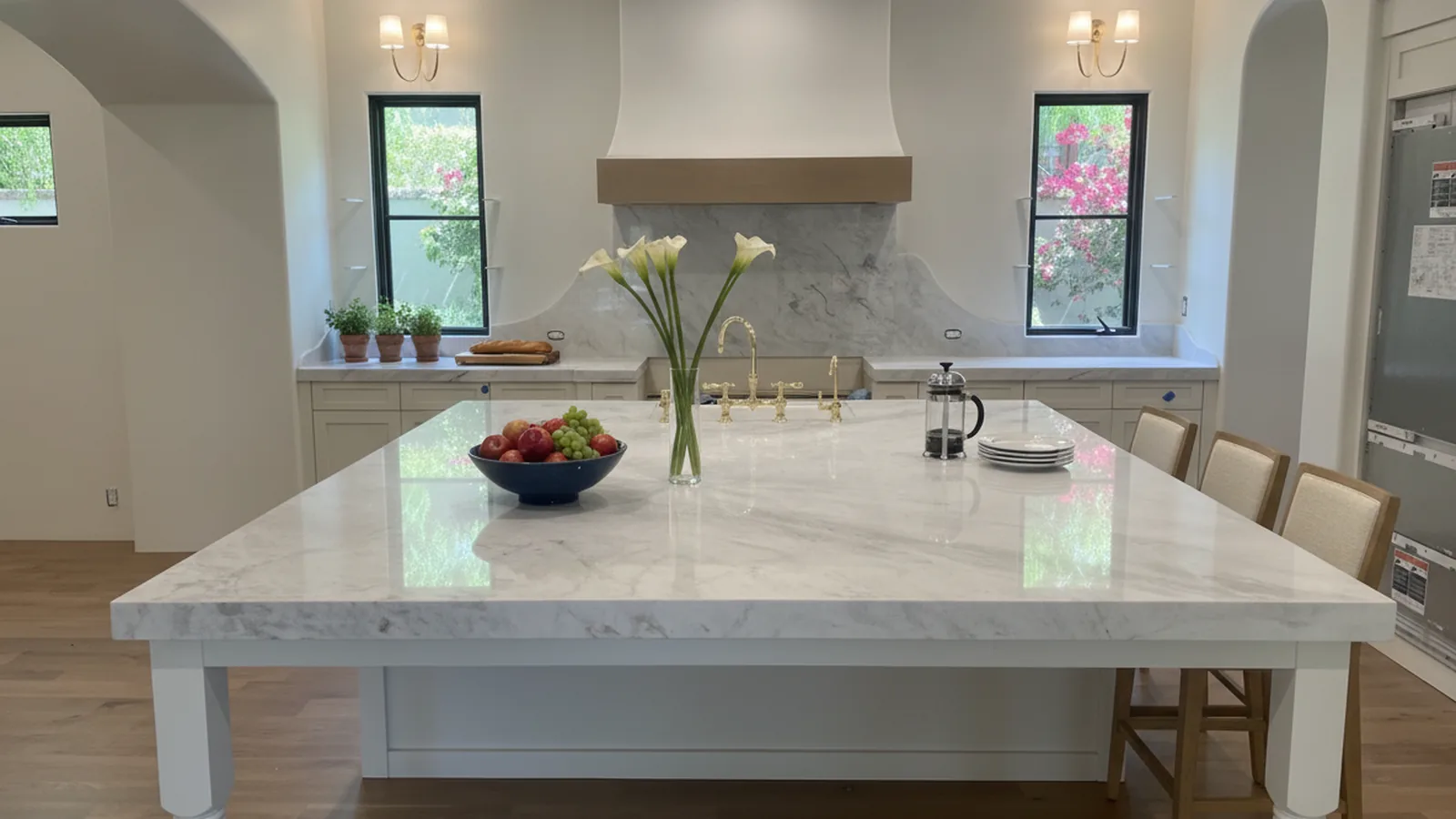
Quartzite is the quiet standout. Not to be confused with engineered quartz, quartzite is a natural stone that often looks like marble but wears much harder and stays stable under both sun and heat. If you love the bright, veiny marble look but need it to survive a west-facing window, quartzite is usually the answer.
Porcelain slabs are increasingly popular for Arizona outdoor kitchens. They’re UV-stable, highly heat-resistant, and nonporous, which shrugs off both monsoon dust and hard water. The look is more uniform than natural stone, but for a poolside built-in, that trade is often worth it.
Engineered quartz is a fantastic indoor surface: nonporous, consistent, and low-maintenance with no sealing required. The catch in Arizona is the resin binder. Under constant, direct sunlight, that binder can yellow or fade over years, which is why it’s the weaker pick outdoors or right against an unshaded window. Indoors and out of harsh direct sun, it performs beautifully. We cover the nuance in do quartz countertops fade in the sun, and if you’re torn between the two most common choices, quartz vs granite in Arizona walks through it in depth.
Marble is UV-stable but soft. It etches from acids and shows hard-water spots quickly, so most Arizona homeowners save it for low-traffic baths rather than a busy kitchen.
Comparison: how each surface handles the desert
| Surface | Direct heat | UV / sun stability | Best Arizona use | Upkeep |
|---|---|---|---|---|
| Granite | Excellent | Excellent | Sunny kitchens, outdoor counters | Seal periodically |
| Quartzite | Excellent | Excellent | Marble look near bright windows | Seal periodically |
| Porcelain | Excellent | Excellent | Outdoor kitchens, poolside | Very low |
| Engineered quartz | Good, not for hot pans | Fair, can yellow in direct sun | Shaded indoor kitchens/baths | Very low, no sealing |
| Marble | Good | Excellent | Low-traffic bathrooms | High, etches easily |
What a heat-worthy countertop costs in Arizona
Countertop cost is driven by the material tier, the slab’s rarity, how much edge and cutout work your layout needs, and how thick the stone is. Exotic quartzite and dramatic natural granite sit at the higher end because each slab is unique and harder to source. Standard granite and mid-range quartz are more approachable. Porcelain pricing varies with the brand and format.
Because every kitchen’s square footage, seams, and edge profiles differ, a firm number only comes from measuring your actual space. Rather than trust an online estimate, it’s worth having someone template the room. Buying from a shop that fabricates in-house also tends to cut out a middleman markup, and asking about remnant stone can stretch a budget on a smaller island or bath vanity. For a real figure on your project, request a free in-home estimate and you’ll get a number tied to your layout, not an average.
What to look for before you buy
A few checks save regret in this climate. Ask specifically about UV performance if any part of the run catches direct sun. Confirm whether the material needs sealing, and how often, so hard water doesn’t dull it. For outdoor installs, make sure the fabricator has actually done outdoor kitchens here and understands thermal movement. And always view the specific slab in person when you can, because natural stone varies piece to piece and photos never capture it.
Frequently asked questions
Can you put a hot pan directly on granite or quartz?
On granite, an occasional hot pan is usually fine because natural stone tolerates high heat, though a trivet is still smart to protect the sealer. On engineered quartz, avoid it: the resin binder can scorch or discolor from direct pan heat, so always use a trivet or hot pad.
Do quartz countertops really fade in the Arizona sun?
They can, over time, in constant direct sunlight. The crushed stone doesn’t fade, but the resin that binds it can yellow after years of intense UV. Indoors and away from harsh, unshaded windows, quality quartz holds its color well, which is why placement matters more than the product.
What’s the best countertop for an outdoor kitchen in Phoenix?
Granite, quartzite, or porcelain. All three resist UV and high heat without breaking down, so they handle direct desert sun and monsoon dust. Engineered quartz is generally not recommended for unshaded outdoor use because prolonged sun can affect the resin.
Does Arizona’s hard water damage countertops?
It doesn’t damage the stone itself, but mineral-heavy water leaves scale that dulls polished finishes and can etch softer surfaces like marble. Wiping up standing water and keeping natural stone sealed keeps that film from building up.
Are dark countertops a bad idea in the desert heat?
Darker surfaces absorb more heat and get noticeably hotter in direct sun, which matters most on outdoor or heavily sun-exposed counters. The color won’t fail structurally on heat-stable stone, but a lighter tone stays cooler to the touch and hides hard-water spots better.
Do I have to seal my countertops in Arizona?
Natural stone like granite and quartzite should be sealed periodically to resist stains and hard-water etching, often once a year depending on use. Engineered quartz and porcelain are nonporous and don’t need sealing, which is part of their low-maintenance appeal indoors.
Which lasts longer in the desert, granite or quartz?
Both last decades. Granite tends to age better in high-heat and high-UV spots because it’s fully sun- and heat-stable, while quartz is the more forgiving daily surface indoors thanks to its nonporous, no-seal finish. The better pick depends on where in the home it’s going.
Choosing with confidence
The best countertop for Arizona heat isn’t a single winner. It’s the material matched to your room’s sun, your water, and how you actually cook. Natural stone earns its keep outdoors and near bright glass, while engineered quartz is hard to beat for an easy indoor kitchen.
If you want that match made for your exact space, the team at AZ Granite & Remodeling in Phoenix will look at your light, your layout, and your goals during a free, no-pressure in-home estimate. Reach out through the contact page or call (602) 759-9000, and you’ll get a straight recommendation built around your home, not a showroom.