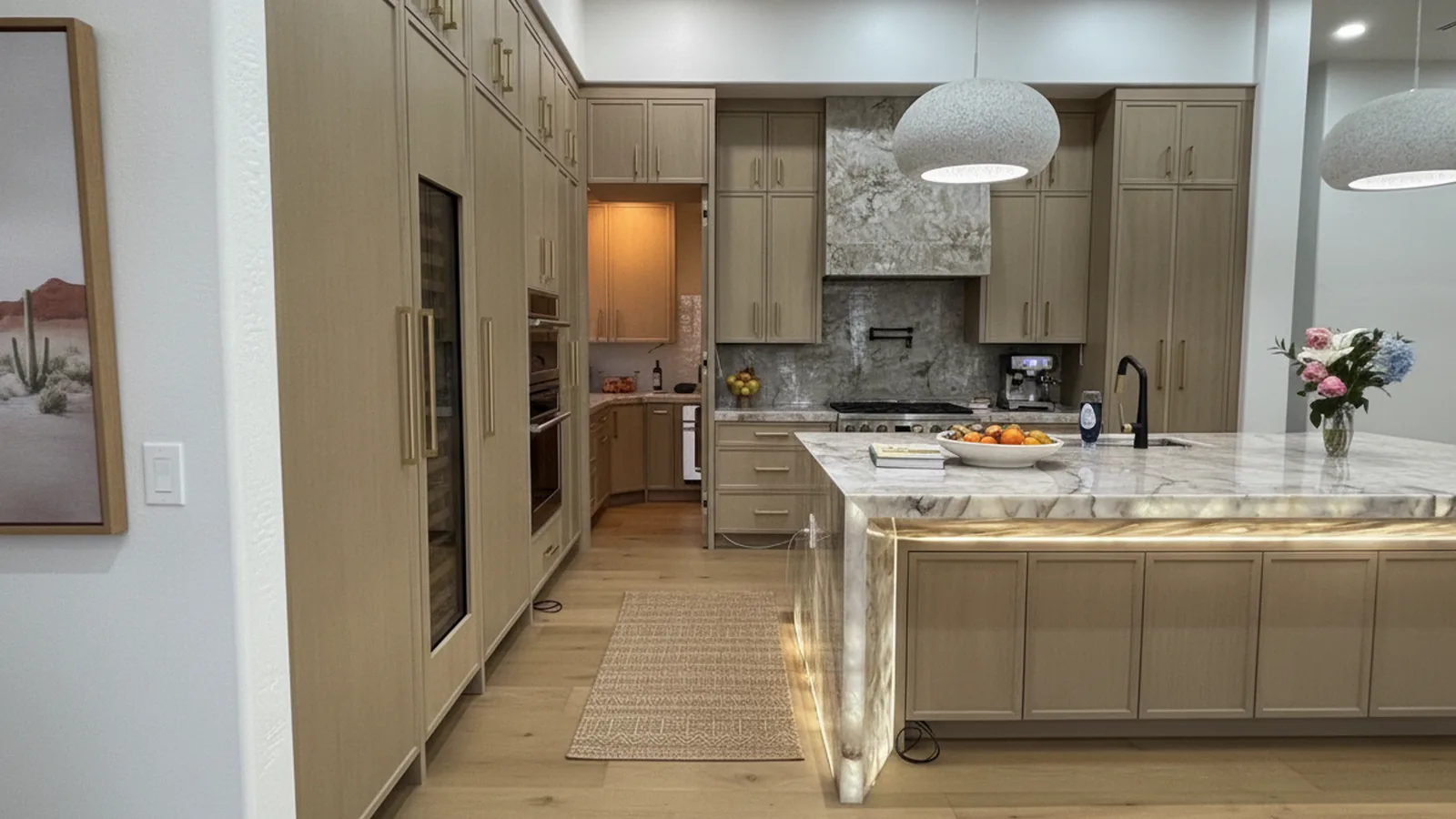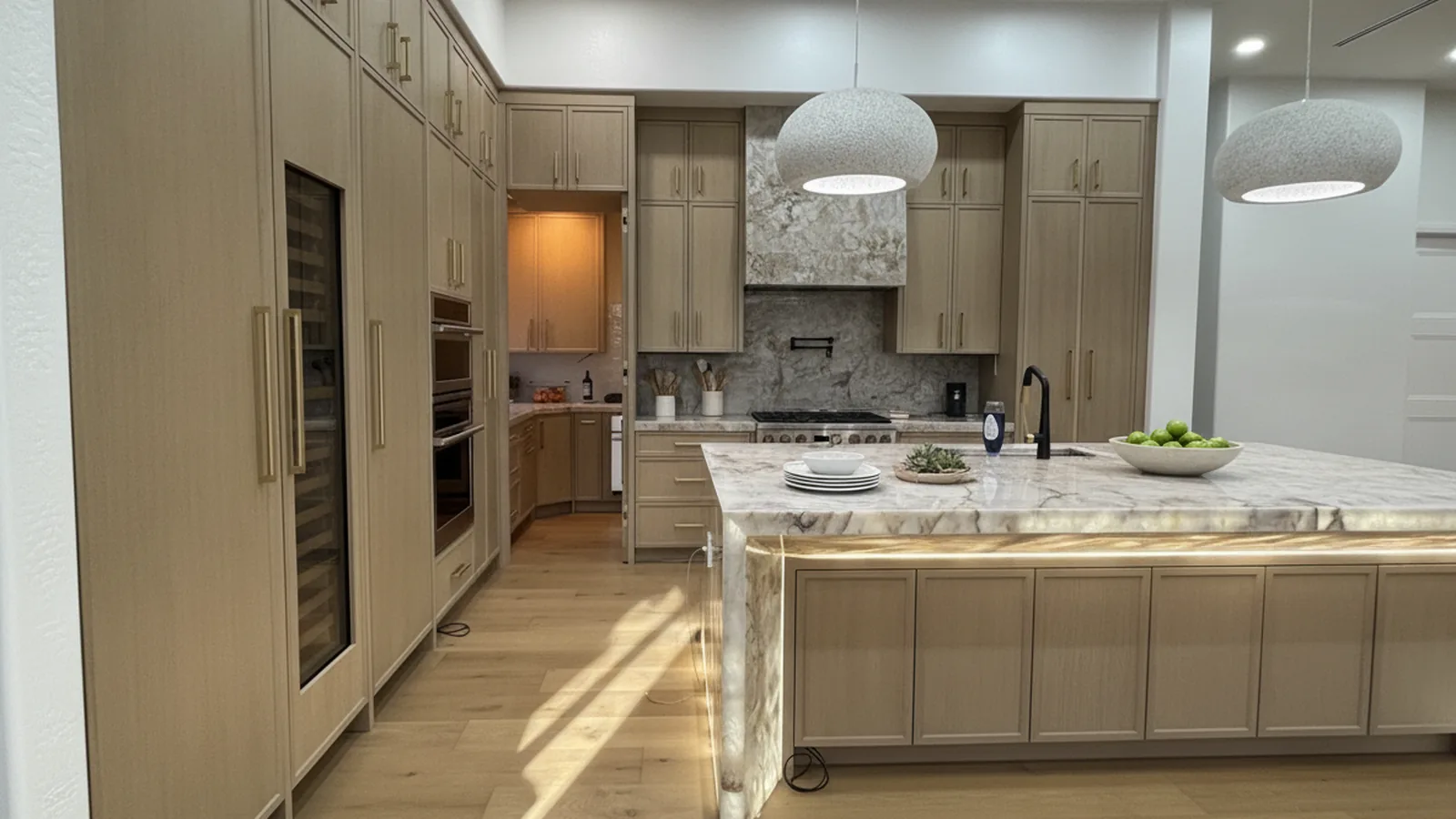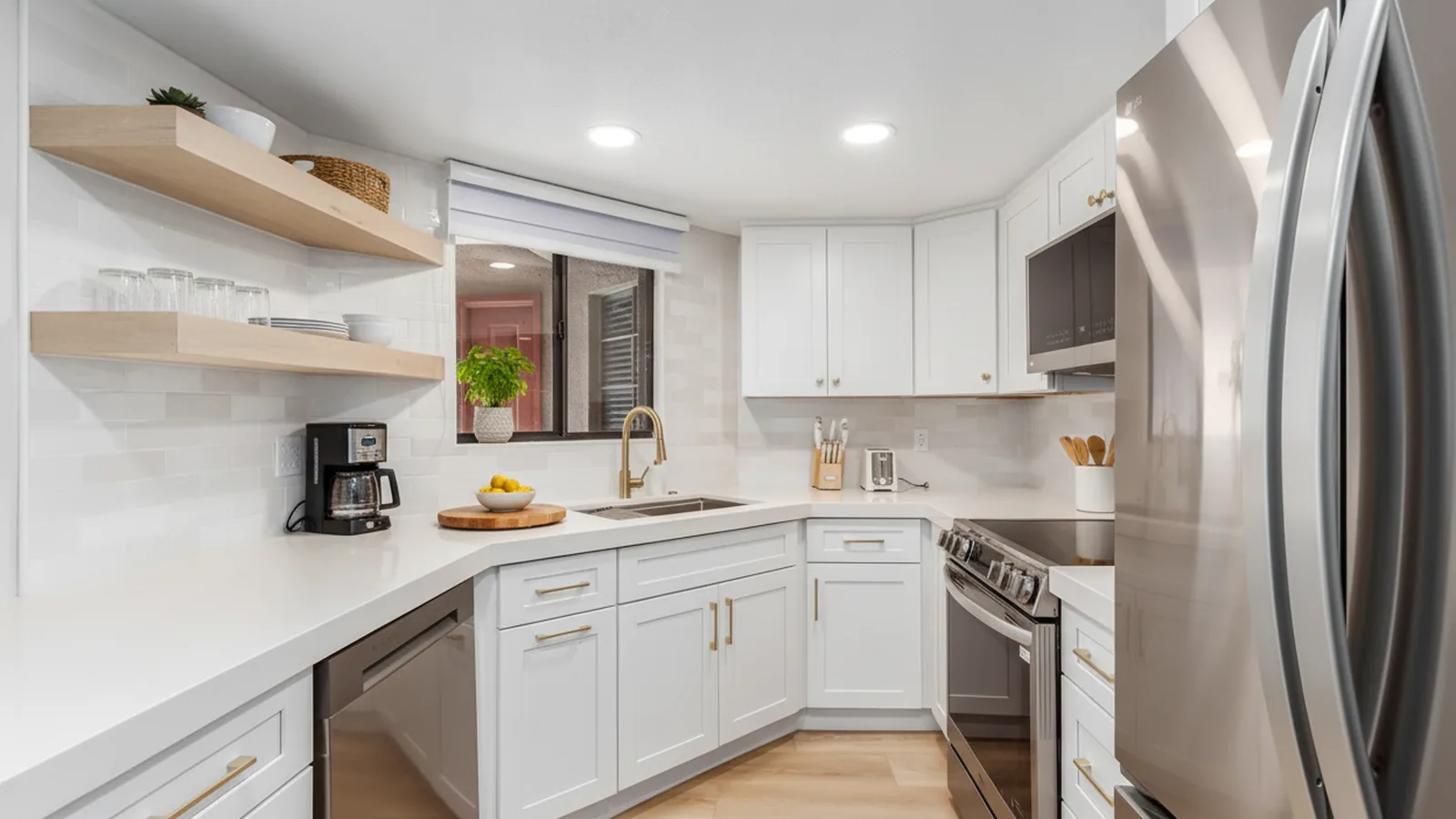
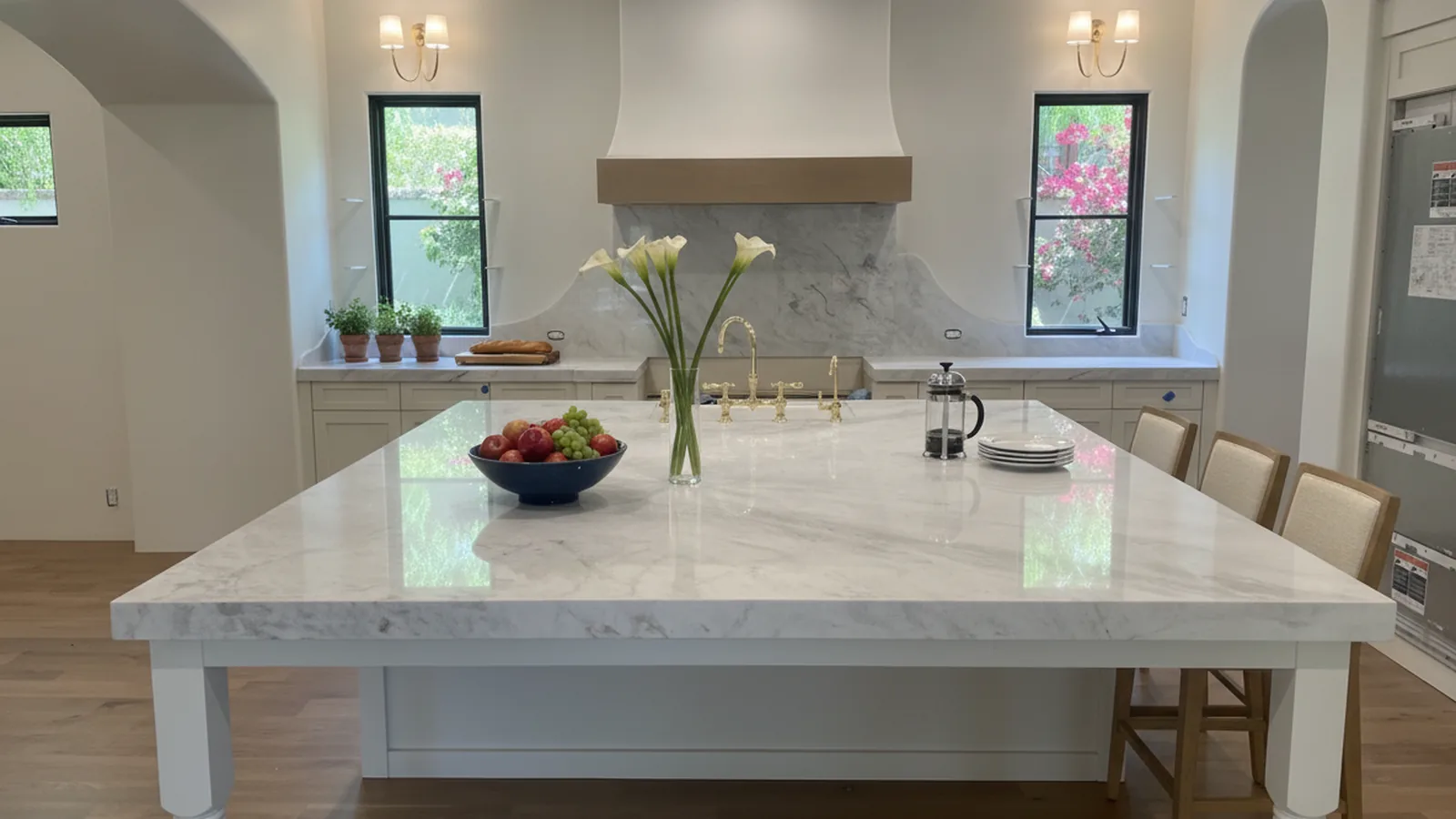
If you’re standing in a slab yard trying to decide between quartz and granite, the salesperson’s answer usually depends on what they stock. The honest answer depends on your kitchen, your budget, and one thing most national guides skip: you live in Arizona, where afternoon sun, hard water, and 40-degree daily temperature swings put countertops through things a kitchen in Ohio never sees.
Both surfaces are excellent. Neither is a mistake. But the trade-offs land differently in the desert, and that’s what this guide is actually about.
Quick answer: For most Arizona kitchens, quartz wins on maintenance and granite wins on heat and direct sun. Quartz never needs sealing and shrugs off hard-water stains, but its resin can be affected by prolonged UV and high heat. Granite handles hot pans and sunlight better and is one of a kind, but it’s porous and needs periodic sealing. The right pick comes down to where the counter lives and how you use it.
Key takeaways
- Granite is natural stone; quartz is engineered from roughly 90% ground quartz bound with resin and pigment. That single difference drives almost every trade-off.
- In Arizona, UV and heat favor granite, especially near big windows or an outdoor kitchen, while hard water and low upkeep favor quartz.
- Installed costs for both commonly land in a similar mid-range band; exotic colors and edges move the number more than the material choice.
- Granite needs periodic sealing; quartz needs none, but quartz dislikes sustained heat and long direct sun.
- Buying from a local fabricator who cuts the slab in-house often matters more than the stone you pick.
What is the difference between quartz and granite countertops?
Granite is a natural igneous rock, quarried in slabs and cut to fit your kitchen, so every piece is unique in color and veining. According to the U.S. Geological Survey, granite is one of the most common rocks in the Earth’s continental crust, which is part of why it’s been a countertop staple for decades.
Quartz countertops are engineered stone. Manufacturers grind natural quartz crystals and combine them with resins and color pigments under heat and pressure to form a slab. The result is a non-porous, consistent surface you can order in a predictable color, from a clean white with no veining to a convincing marble look-alike. So the plain-English version: granite is dug out of the ground and finished, quartz is manufactured to spec. You can see the full range of both, plus quartzite and porcelain, on the materials overview.
That natural-versus-engineered split is the root of everything below. Because granite is stone all the way through, it laughs at heat and sun but has tiny natural pores that need sealing. Because quartz is bound with resin, it wipes clean and looks uniform, but that resin is the one part that reacts to extreme heat and long UV exposure.
Why Arizona changes the quartz vs granite math
Arizona changes the answer because the desert stresses countertops in three specific ways: sun, heat, and hard water. Each one nudges the decision, and this is the part a generic national comparison can’t tell you, so it’s worth reading before you fall in love with a slab.
Sun and UV. Arizona kitchens get intense, direct light, and homes here love big windows and glass sliders. Prolonged UV can, over years, cause the pigments and resin in some quartz to lighten or yellow, which is exactly why we get so many questions about whether quartz countertops fade in the sun. Granite, being natural stone, is essentially UV-stable. If your island sits in blazing afternoon light or you’re planning an outdoor kitchen, that’s a real point for granite.
Heat. Both surfaces take normal kitchen heat fine, but granite tolerates a hot pan off the burner better than quartz. Quartz’s resin can scorch or discolor under sustained high heat, so a trivet is not optional with it. In a state where people actually cook outdoors half the year, heat tolerance matters.
Hard water. Phoenix Valley tap water is notably hard, loaded with dissolved minerals that leave chalky spots. On unsealed or under-sealed granite, that mineral-heavy water can etch or stain over time. Non-porous quartz simply wipes clean, which is one of its strongest real-world advantages in the desert.
Where AZ Granite & Remodeling fits in
AZ Granite & Remodeling is a Phoenix design-build shop that fabricates its own stone, which is exactly the kind of local fabricator this decision calls for. The company has served the Phoenix Valley for over 20 years, and unlike a retailer that outsources the cutting, it runs its own fabrication shop at 1923 W. Cheryl Dr in Phoenix. You work one-on-one with a designer, and the same team designs, fabricates, and installs. That one-team, one-shop setup is the difference between guessing and knowing how your slab will behave in an Arizona home.
Practically, that matters for this exact decision in a few ways. Because AZ Granite carries granite, quartz, quartzite, marble, dolomite, porcelain, and onyx, nobody there is pushing quartz just because that’s all they stock. You can compare the actual granite countertop options against the quartz countertop options side by side and hear an honest read on which suits your light, your layout, and your cooking habits. The estimate is free, in-home, and no-pressure, so a designer sees your actual windows and sun exposure before recommending anything.
There’s a budget angle worth knowing, too. Full-slab jobs leave offcuts, and AZ Granite sells those granite remnants by appointment at the Phoenix shop. For a bathroom vanity, a small island, or a laundry counter, a remnant can get you premium natural stone at a fraction of a full-slab price. The company serves North Scottsdale, Desert Ridge, Peoria, Sun City, Anthem, and the rest of the East and West Valley. When you’re ready to price your own project, the contact page is where you book that free estimate.
That’s the local option. The rest of this guide stays on the general decision so you can judge any fabricator you talk to.
Quartz vs granite: a side-by-side comparison
Granite and quartz differ most on heat, UV, upkeep, and uniqueness, and the table below lays out how they stack up on the factors that actually decide most Arizona kitchens.
| Factor | Granite (natural stone) | Quartz (engineered stone) |
|---|---|---|
| Heat resistance | Excellent; handles hot pans | Good, but resin can scorch under sustained heat |
| UV / direct sun | Essentially UV-stable | Some colors may fade over years of strong sun |
| Hard-water stains | Possible if sealing lapses | Non-porous; wipes clean |
| Sealing / upkeep | Reseal periodically | None required |
| Look | Unique, natural veining | Consistent, made-to-order colors |
| Best for | Sun-lit islands, outdoor kitchens | Low-maintenance, hard-water-heavy homes |
| Uniqueness | Every slab one of a kind | Predictable, repeatable |
The pattern is clear: granite for durability in tough sun and heat, quartz for low maintenance and consistency. Neither is universally better. The winner is whichever one matches how that specific counter gets used.
What each one really costs in the Valley
Quartz and granite land in a broadly similar installed price range for standard colors, so the material you choose is rarely the biggest line item. What actually moves the number is the stuff underneath the headline:
- Color and rarity. An exotic granite or a designer quartz can cost several times a builder-grade option in either material.
- Square footage and layout. More counter, more seams, and complicated corners raise labor.
- Edge profile. A simple eased edge is cheaper than an ogee or mitered waterfall.
- Cutouts and backsplashes. Sinks, cooktops, and full-height backsplashes add fabrication time.
- Old-counter removal and plumbing disconnects.
Because those factors swamp the quartz-vs-granite difference, chasing a material to save money usually backfires. A better move is to set a total budget, then let a fabricator show you both materials that fit it. For a small vanity or bar top, remnants can stretch that budget hard. Any firm price for your kitchen should come from an in-home measurement, not a per-square-foot number off the internet, because your layout is doing most of the pricing.
How to choose for your specific Arizona kitchen
Choose the surface based on where it lives and how you cook, not on which one is trendy this year. A few honest rules of thumb:
Pick granite if your counters sit in strong, direct sunlight, you have an outdoor or indoor-outdoor kitchen, you set hot cookware down without thinking, or you simply want a one-of-a-kind natural slab and don’t mind sealing it once in a while.
Pick quartz if you want a surface you can basically ignore, you’re tired of hard-water spotting, you want a specific consistent color across a big island, or you’re matching a clean, modern look with minimal veining. Just keep it out of sustained direct sun and always use a trivet.
Consider quartzite if you love the marble look but need real-world toughness. It’s natural stone that wears harder than marble and resists the desert’s hard water better. It’s a genuine third option a lot of Valley homeowners never hear about. If you’re weighing a broader kitchen project rather than just the counter, browsing a gallery of finished work helps you see these materials in real Arizona homes before you commit.
Frequently asked questions
Which is better for Arizona, quartz or granite?
Neither is better across the board; it depends on where the counter lives. Granite is the safer pick for surfaces in strong direct sun, near big windows, or in an outdoor kitchen because it’s UV-stable and handles heat. Quartz is better where low maintenance and hard-water resistance matter most, like a busy interior kitchen.
Do quartz countertops really fade in Arizona sun?
Some can, over years of intense, prolonged UV exposure, because quartz contains resins and pigments that natural stone doesn’t. It’s usually gradual and worst in spots with all-day direct light. If a counter sits in heavy sun, granite or quartzite is the more sun-safe choice; otherwise quartz holds up fine indoors.
Does granite really need sealing, and how often?
Yes, granite needs periodic sealing because it’s a natural stone with tiny pores that can absorb liquids and hard-water minerals if left bare. Most granite benefits from resealing on a periodic basis, often roughly once a year, though it varies by the specific stone. A quick water-drop test tells you when it’s time: if water beads, you’re sealed; if it soaks in, reseal.
Is quartz or granite more heat-resistant?
Granite is more heat-resistant because it’s solid stone and can take a hot pan directly, while quartz’s resin binder can scorch or discolor under sustained high heat. With quartz, always use a trivet or hot pad. This is why granite is often preferred for outdoor kitchens and heavy-cooking households in the Valley.
Are granite countertops safe? I’ve heard about radon.
Granite countertops are considered safe for the vast majority of homes. The U.S. Environmental Protection Agency notes that the radon and radiation from typical natural-stone countertops is generally very low and not a health concern, even though granite can contain trace natural radioactive elements. If you’re ever unsure, an inexpensive home radon test measures the whole house rather than the counter alone.
Which adds more resale value in Phoenix?
Both are viewed as premium upgrades and appeal to buyers, so either can help a kitchen show and sell well. Granite reads as classic natural stone, while quartz reads as modern and low-maintenance. What matters most for resale is quality fabrication and a color that fits the home, not the material label itself.
Can I mix quartz and granite in the same kitchen?
Yes, and plenty of Valley homeowners do. A common approach is durable granite or quartzite on a sun-exposed island and easy-clean quartz on the perimeter, or a dramatic natural stone on a feature bar with quartz everywhere else. A designer can help balance the look so it reads intentional rather than mismatched.
How do I get an accurate price for my project?
Have a fabricator measure your kitchen in person, because layout, edge profile, cutouts, and slab rarity drive the cost far more than the quartz-vs-granite choice. Online per-square-foot figures are only rough starting points. A free in-home estimate, like the one AZ Granite & Remodeling offers across the Phoenix Valley, gives you a real number for your actual space.
AZ Granite & Remodeling · 1923 W. Cheryl Dr, Suite 2, Phoenix, AZ 85021 · (602) 759-9000 · Serving the Phoenix Valley for 20+ years with in-house stone fabrication and free, no-pressure in-home estimates.